Table of Contents
SEO automation for AI Search is not about "mass publishing". In classic SEO you could operate for a long time on a simple scheme: keyword research, brief, publication, indexing, rankings. With AI Sea...
SEO automation for AI Search is not about "mass publishing"
In classic SEO it was possible for a long time to operate on a simple scheme: keyword research, brief, publication, indexing, rankings. With AI Search that model begins to break down. Not because Google or language models have "replaced SEO", but because the answer layer has been rebuilt. Users increasingly do not land directly on a list of results, but on a ready-made synthesis, summary, or compilation of sources. This changes how content is designed, published, and monitored.
The biggest problem is not in writing itself. It lies in operationalization. Companies today have dozens or hundreds of topics, many product entities, dispersed data sources, and an editorial team working in several tools at once. Without a pipeline, automation usually ends in one of two places: either the team publishes too little to build topical authority, or it publishes too much content without quality control, entity consistency, and intent coverage. In both cases it's hard to gain visibility in Google, and even harder to get citations by generative answer systems.
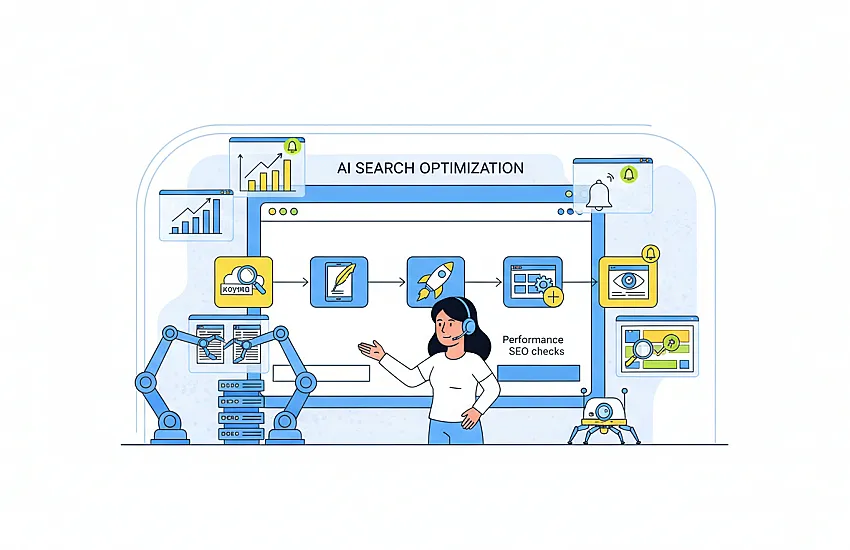
In practice, SEO automation for AI Search is not a single process but a connected operational chain: topic acquisition, intent mapping, entity building, draft generation, expert editing, publication, technical validation, and monitoring presence in search engines and answer engines. Only such a setup makes business sense. A content generator alone does not solve the problem.
Where the problem really appears: between intent and publication
Most content teams don't lose because they don't know keywords. They lose because they can't transform search signals into a repeatable publication process. In the AI Search environment it matters not only whether a page answers a question, but whether it does so in a way that is easy for a system that builds a synthetic answer from multiple sources to understand.
If the topic is "SEO automation for AI Search", a commercial user is not looking for a definition. They are looking for an operating model. They want to know how to build a process that will allow scaling publication without losing quality, how to measure presence in AI Overview, how to prepare content for citations, and how to connect that with sales objectives. That means content must simultaneously cover strategic, technical, and operational layers.
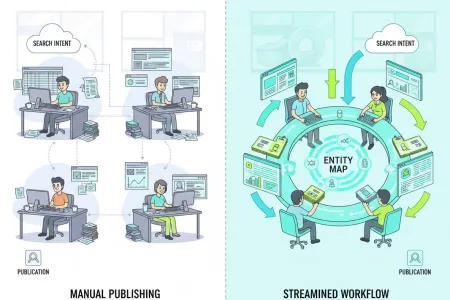
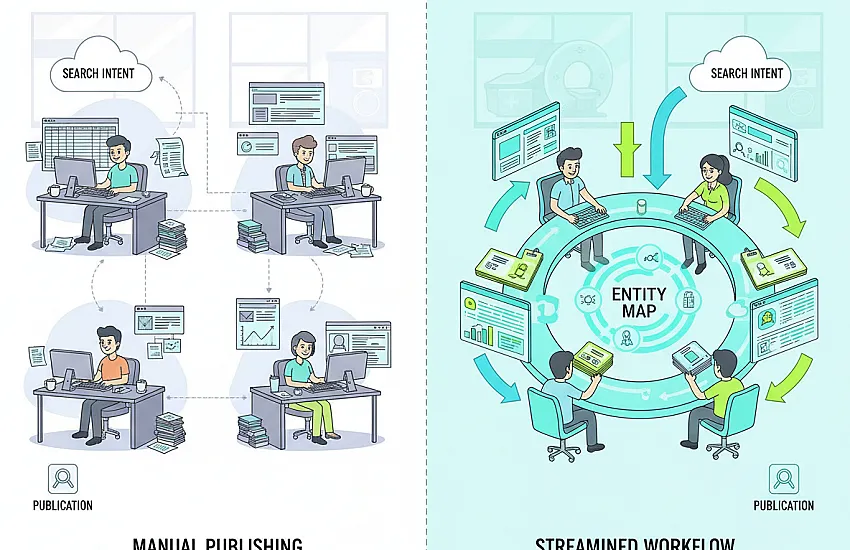
This is where the pipeline becomes critical. Without it a company acts reactively. One specialist does research in a spreadsheet, another writes in an editor, a third manually publishes in the CMS, and a fourth checks rankings a week later. In that model it's impossible to quickly test content structures, update entities, or respond to changes in AI Search behavior.
AI Search rewards structured content, not just "long"
Google indicates that ranking systems still focus on helpful, reliable content created for people, not solely for rankings [1]. From a practical perspective this means something very specific: automation cannot mean flooding a site with variants of texts. If content does not bring new information, lacks a clear structure, and does not organize the topic around entities and intents, it will not be a good candidate for organic ranking nor for citation in AI answers.
Google AI Overviews show users summaries generated from multiple sources and direct them to links that support the answer [2]. For a site owner this changes the definition of "visibility." It's not only the URL's rank for a keyword that matters, but whether a given fragment of content is precise, unambiguous, and credible enough to become part of a system-generated answer.
What an effective SEO pipeline for AI Search looks like
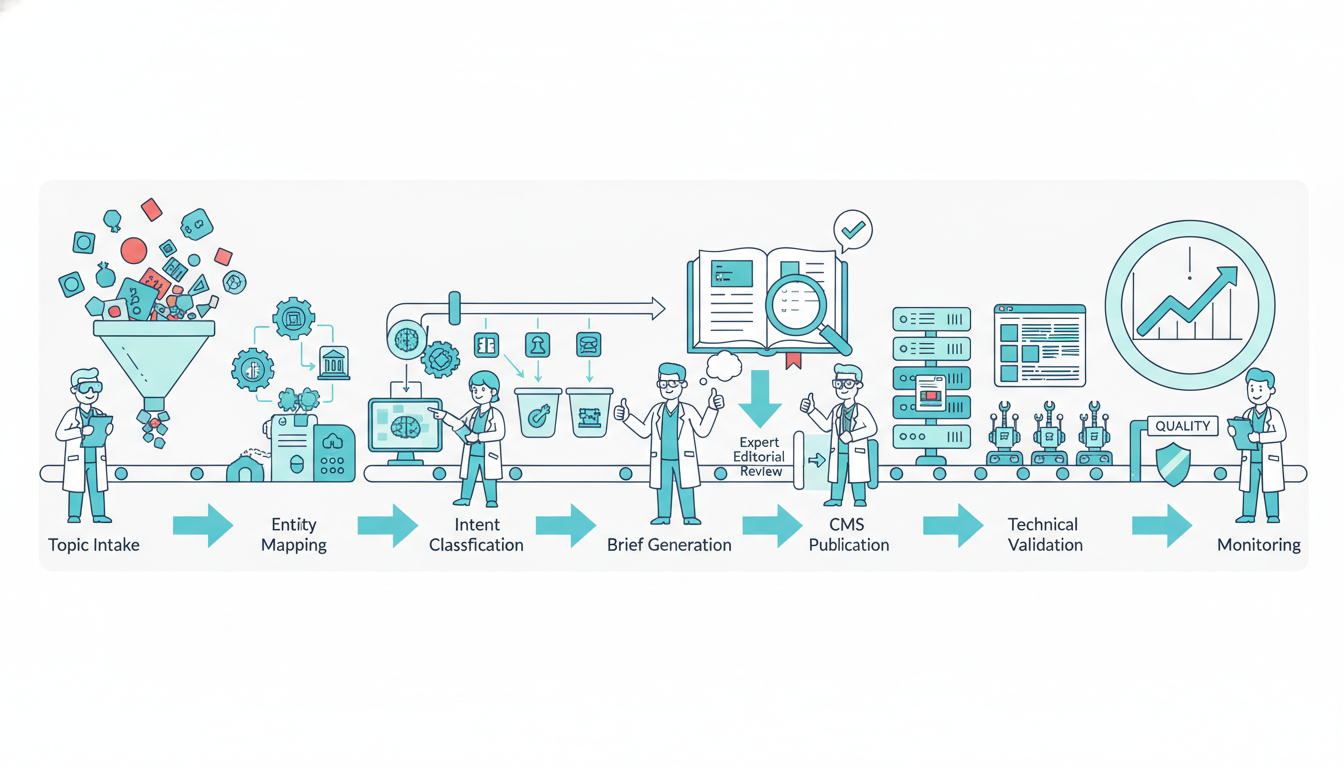
An effective pipeline does not start with a language model. It starts with input data. In a well-structured process each stage has its own function and quality criteria. If a company skips any of them, automation accelerates errors instead of strengthening results.
1. Input layer: sources of topics, entities and intents
The first stage is feeding the pipeline with data. It’s not only about a list of keywords from an SEO tool. You also need PAA questions, queries from the internal search, CRM data, sales logs, sales conversations, competitor content, threads from Reddit, YouTube and LinkedIn. For commercial topics queries like "how to choose", "how much does it cost", "what to implement", "how to compare approaches" and "how to measure the effect" are especially valuable. These most often signal readiness to talk to a provider.
At this stage you also build the entity map. An entity is not only a product or service, but also a problem, process, system, metric, standard and technology. In the topic of SEO automation entities include: CMS, publishing workflow, schema, visibility monitoring, AI Overview, content cluster logic, source-of-truth for data, content versioning, or quality scoring. Without this layer content can be linguistically correct but semantically flat.
2. Topic classification: TOFU, MOFU, BOFU and operational intent
This is a stage often skipped, and then there's surprise that traffic does not convert. A topic with commercial intent should not be handled the same way as an educational guide. In the pipeline it's worth assigning to each topic not only a funnel stage but also the expected response format. You build an article differently for an exploratory query than for a person who already understands the problem and is assessing implementation options.
When automating SEO for AI Search the user usually wants answers like: how it works in practice, what components make up the process, what dependencies exist between content, publication and monitoring. That means emphasis on the process architecture, not academic definitions.
3. Generating briefs instead of generating finished articles
This is one of the most important differences between amateur automation and a mature process. Language models greatly accelerate creating briefs, H2/H3 structures, lists of entities, auxiliary questions and proposed sections. They perform much worse as the sole source of final expert content, especially in niche B2B topics. Therefore a sensible pipeline should automate preparation of editorial material, not mindlessly publish the raw output.
A well-built brief contains: the main intent, secondary intents, key entities, expected technical level, section structure, side queries, EEAT requirements, internal linking and elements that must be confirmed manually. This way an editor or subject matter expert does not start from scratch, but also is not forced to fix the entire text from the ground up.
4. Expert editing and substantive validation
This stage decides whether content has a chance to be cited. AI models and search engines handle content better when it is concrete, coherent and grounded in practice. A generic article, even if stylistically correct, rarely becomes a preferred source for answers. Operational details are needed: what the process looks like, where bottlenecks appear, what input data is necessary, which elements can be automated and which should remain human-controlled.
In practice expert editing often consists of adding what is missing in the raw model draft: implementation constraints, CMS-related nuances, differences between content types, real dependencies between content ops and the technical SEO team. These are the fragments that build usefulness and credibility.
5. Publication via API, CMS or an intermediate layer
Publication automation only makes sense when you control the output standard. Otherwise chaos arises. Every entry should pass a set of validations: header correctness, structured data, presence of required sections, internal linking, canonical, indexability, author tags, update dates and conformity with the content type template.
In companies that publish a lot, an intermediate layer between generation and the CMS works well. This can be a simple editorial panel, a workflow in Airtable, Notion, a headless system or a custom dashboard. The point is that publication should not be a "drop-in" but an approved step of the process. For product and medical topics such rigor is even more important, because substantive or technical errors have greater consequences for trust. This also applies to content supporting the visibility of categories such as Holter monitors or ECG electrodes, where the user expects precision, not marketing fluff.
6. Monitoring: not only rankings, but presence in AI answers
If a team still measures only keyword rankings and organic sessions, it only sees part of the picture. In AI Search you also need to monitor: the appearance of a page in AI Overviews, domain citations in answer tools, CTR change for informational queries, participation in featured snippets, indexing stability and which fragments of content are most often used as intermediate answers.
Google states that links in AI Overviews lead to sources that can be used for further exploration of a topic [2]. From an operational point of view this means the need to monitor not only URL visibility but also the domain's share in synthetic answers. This is a new analytical layer that cannot be sensibly managed solely through classic ranking reports.
Automated publication vs controlled publication: the difference is fundamental
In many organizations the word "automation" is understood too broadly. If a system collects topics on its own, creates a draft, inserts it into the CMS and publishes without supervision, that's not a mature process. It's an accumulated risk. Controlled publication works differently: you automate repeatable steps, but control points remain in the hands of humans or quality rules.
The most mature teams do not automate everything. They automate what is predictable: topic extraction, keyword grouping, entity mapping, brief creation, meta data generation, draft building, basic linking, schema tagging, publication scheduling and monitoring alerts. Decisions about editorial angle, level of specialization, source credibility and final content are still controlled. And rightly so.
Where automation provides the greatest operational return
The biggest gain usually appears not in writing itself, but in eliminating manual handoffs between stages. Example: a team has 300 topics in the backlog. Without a pipeline each topic requires manual research, a separate brief, individual linking decisions and manual publication. With a pipeline you can automate topic classification, detect duplicate intents, create article structures, attach entities, prioritize by potential and prepare publication batches.
This is exactly where scale starts to work for quality, not against it. A well-designed system ensures the standard of every publication. A bad system only accelerates the production of mediocre content.
How to prepare content that has a chance of being cited by AI models

Citatability doesn't come from publication alone. Answering models prefer content that can be easily extracted, understood and mapped to a specific question. This has several practical implications for editorial teams.
Precise sections addressing individual problems
If one section tries to answer five questions at once, it's harder to use as a source. Blocks that solve one specific problem work much better: how the pipeline works, how validation is carried out, what should be measured after publication, when automation harms quality. Such a layout helps both the user and systems extracting answers.
Operational language instead of declarative
Content like "automation increases efficiency" has little value. Content like "automation shortens the time from research to publication if the pipeline has a shared entity model and quality validation before pushing to the CMS" does. The second construction contains a process, a condition and context. It is useful. And usefulness is the basis of citability.
Explicit credibility signals
Google, in its documentation on helpful content, emphasizes the importance of the author's and the site's experience, expertise and trustworthiness [1]. In practice for automation content this means showing that the text is not a compilation of definitions. The following help: a named author, updating dates, consistent industry vocabulary, a clear breakdown of the process, no exaggeration in promises, and basing claims on verifiable sources where specific facts appear.
Monitoring that makes business sense
After implementing the pipeline the most common mistake is looking only at the increase in the number of published URLs. That's a vanity metric. For commercial topics other questions matter: do the new contents capture high-intent queries, are they picked up by AI Overview, does traffic to service pages increase, does internal linking to conversion pages improve, and does the domain become more frequently present on problem-solution queries.
In practice monitoring should be multilayered. The first layer is classic SEO: indexing, rankings, CTR, traffic, cluster visibility. The second is AI Search signals: presence in answers, sources of citations, domain share in summaries, changes after algorithm updates. The third is content metrics: update speed, content decay, degree of entity coverage, completeness of internal linking. The fourth is business effect: transitions to offer pages, increase in inquiries, quality of leads.
Without such a setup it's easy to draw wrong conclusions. An article may have moderate traffic and at the same time work very well as an entry to an offer. Another may rank highly but not support sales or citability. The pipeline must be evaluated not by production volume, but by the quality of its impact.
The most common implementation constraints that only surface after launch
At the planning stage automation usually looks simple. Problems begin later. Most often where data and responsibility are dispersed. SEO has its own tools, content its own, the product department its own, and the development team its own backlog. In such a setup the pipeline becomes a patchwork of semi-automatic steps that have no single owner.
The second constraint is the lack of a quality model. If an organization cannot unambiguously assess whether content is ready for publication, automation will produce conflicts. One editor will consider the material sufficient, another will send it back for revision, a third will publish it without structural data. The pipeline needs criteria. Not general ones. Concrete and measurable.
The third problem is updating. AI Search rewards sources that are consistent and up-to-date. If an organization can publish but cannot refresh content, editorial debt begins to grow after a few months. Then even a well-built cluster loses semantic sharpness. This is especially visible in areas where procedures, standards and tools change frequently, but it also applies to specialized categories in which users expect reliable information about use and specifications, such as with oximeters and pulse meters.
What distinguishes a working pipeline from a pipeline that only looks good on a diagram
A working pipeline has three characteristics. First, it is fed by real user questions, not only by an export of keywords. Second, it has a shared entity layer and quality standards, which prevents content from diverging semantically. Third, it has monitoring that covers both SEO and AI Search.
A pipeline that only looks good usually has impressive automation at the input and very weak control at the output. It can generate 50 drafts a day, but it doesn't answer which of them are worth publishing, which support sales, and which build a chance of being cited. In the generative search environment such a gap quickly backfires. Answer systems do not reward scale for its own sake. They reward sources that are readable, organized and trustworthy.
Therefore SEO automation for AI Search is not a "content" project in the narrow sense. It's a process that combines SEO, editorial, data, technology and analytics. If these layers are not connected by a single operating model, publication will be fast, but advantage will not arise. And it's that advantage that matters here.
Case study: SEO automation for AI Search at a medical equipment distribution company
Topic: pipelines, publishing and monitoring content for Google and answers generated by AI models.
Intent: commercial — the user was not looking for definitions, but a proven way to implement a process that can be maintained within a team.
Brief context
A company from the medical equipment distribution sector approached us. Not a manufacturer, but a specialized supplier serving facilities, clinics and smaller purchasing organizations. The site had an e-commerce section, a catalog section and an extensive advisory backend that had been developed irregularly over the years.
At first glance, this was not a “lack of SEO” case. The site had history, many indexed subpages, a reasonable link base and a dozen categories with real traffic. The problem was something else: the company was losing visibility for comparative and purchase queries, and its content rarely appeared as sources in answers generated by AI tools. This particularly affected queries related to device selection, operation and differences between product variants.
The client also had an ambition to speed up publishing. The marketing team wanted to create more content, but the product department and people responsible for factual accuracy could not keep up with approvals. As a result, many topics stayed in spreadsheets for several months.
Client problem
The main problem was not: “we need more articles.” It was rather: “we can’t deliver content at a pace that allows us to react to market queries, and at the same time we fear automation because in our industry a factual error can have serious consequences.”
On the business side there were three tensions visible:
traffic from the advisory section was growing slower than the number of commercial queries reported by the sales team,
product categories had too little semantic support from educational and comparative content,
monitoring covered mainly rankings and traffic, but did not show whether the brand appears in AI answers or for which questions.
The most problematic content was on the border between education and purchase. For example, a user looking for information on how to choose electrodes for testing did not necessarily type the name of a specific product right away. They often started with questions about use, compatibility, type of test or reading errors. Only then did they move to categories like EKG electrodes.
We saw the same with longer purchase journeys. People interested in ambulatory diagnostics or monitoring vital signs rarely went straight to the cart. First they compared procedures, device features, recording time, usage conditions and staff requirements. From the perspective of SEO and AI Search these were high-value topics, but the client had no process to handle them systematically.
Situation analysis
We did not start with a publication plan, but with checking where the process was stuck. For the first two weeks we analyzed the publication history, exports from Google Search Console, queries from the internal search, salespeople’s notes, category structure and the editorial workflow.
Four concrete problems emerged.
1. The topic backlog was large but not organized by intent
The sheet contained over 240 ideas. Some were good, some very general, some duplicated existing content. Topics mixed informational questions, comparisons, product queries and brand-building ideas. It was impossible to build a sensible schedule from this.
Example: three separate topics concerned monitoring heart function, but each was written in a different language. One as a patient guide, another as a device description, the third as material for clinics. In practice they needed to be separated into distinct intents and linked to the Holter monitors category, rather than producing three similar articles.
2. Content did not have a single source of product data
Editors used manufacturer descriptions, old PDFs, product sheets, sales catalogs and answers from salespeople. Sometimes these sources differed in details. These were not huge discrepancies, but enough to delay approval.
In one draft a different term was used for a measurement method than in the current product documentation. The text was not published for three weeks because no one wanted to take responsibility for the correction. This signaled that automation without organizing sources would only increase the number of such blocks.
3. The CMS did not support controlled publishing well
The system allowed quick addition of posts, but lacked validation. It was possible to publish an article without an author, without an update date, with a random H1 or without linking to a category. There were also differences in table formatting, so comparative content looked different depending on who published it.
4. Monitoring did not answer business questions
The monthly report showed organic traffic, rankings for selected phrases and the number of published pieces. It did not show, however, which articles support category entries, which queries generate leads or whether the domain appears in answers from tools such as ChatGPT, Gemini, Perplexity or Copilot.
Approach to the solution
We did not implement automation as a separate “AI for writing” project. We agreed with the client that the goal would be to build a controlled pipeline: from market signal, through brief and approval, to publication and monitoring of visibility in Google and AI Search.
We adopted a simple rule: automate repetitive elements, but do not remove substantive responsibility from people. In this industry that is especially important because texts concern equipment, parameters, applications and procedures. Errors are not always spectacular, but they can undermine trust in the entire domain.
Step-by-step actions
Step 1: cleaning the backlog and topic scoring
Instead of adding more ideas, we first organized the existing ones. Each topic received several labels:
stage of the user journey: TOFU, MOFU or BOFU,
intent: informational, comparative, product, problem or purchase,
related categories and products,
potential for a snippet, PAA or AI answer,
factual risk, i.e. level of required expert approval,
sales priority based on CRM data and conversations with salespeople.
This quickly showed that some high-volume topics were not the best choice. They had weak purchase intent and little relation to the offer. Meanwhile, several long-tail queries looked modest in SEO tools but often appeared in conversations with clients. We moved those topics up.
Step 2: building a small knowledge repository
Before automating briefs we created a data repository the team could use. It was not an elaborate tool. An organized base with category descriptions, typical uses, forbidden phrases, preferred terminology, links to documentation and notes from product people was sufficient.
The repository covered categories related to diagnostics, monitoring and basic facility equipment. For content on vital sign control we naturally linked articles to the oximeters and pulse meters category, but only where the user actually might need to check products further. We avoided mechanical linking.
Step 3: automated briefs, but with manual angle selection
We created a semi-automatically generated brief template. The system pulled the topic, intent, related entities, user questions, suggested headings, required internal links and sections for validation. It did not, however, generate the final article for publication.
The most important change concerned the editorial angle. For each topic the editor chose one dominant perspective: medical user, purchasing person, clinic owner, technical staff or a person comparing solutions. As a result, texts stopped being too broad.
For example, a topic about blood pressure measurement was split into three separate pieces: one about measurement errors, a second about selecting devices for a facility, and a third about operation and accessory maintenance. Only the third text linked to the blood pressure measurement category, because there the user intent was closest to checking the offer.
Step 4: quality control before publication
We implemented a simple validation checklist. Each text had to pass several points before publication:
does it answer one main intent, instead of mixing several topics,
does it contain a short answer section that can be extracted by answer systems,
does it use terminology consistent with the repository,
does internal linking lead to genuinely related categories,
were product data not added based on guesses,
does the article have an assigned author, update date and schema type.
The list was deliberately short. Previously the client tried to implement an approval card covering over 40 points. Nobody used it consistently. We limited it to elements that actually blocked publication or affected visibility.
Step 5: publishing through an intermediary layer
We did not integrate everything with the CMS immediately. That would have been too big an organizational change. First we created an intermediary layer in the form of an operational table and a simple status panel: topic, brief, draft, proofreading, product approval, publication, monitoring.
Only after a month, when the process stabilized, did we add automatic transfer of selected fields to the CMS: meta title, meta description, slug, author, update date, suggested links, schema type and indexing status after publication. This reduced editorial errors but did not force a revolution in the team’s work.
Step 6: AI Search monitoring on a sample of queries
We established a set of 80 test queries. These were not only SEO phrases. Some sounded like questions asked to a salesperson or consultant: “how to choose electrodes for an EKG test”, “what is the difference between a Holter and a short EKG test”, “what errors affect saturation measurement”, “what to check before buying a blood pressure monitor for a clinic”.
Once a month we checked the domain’s presence in Google, AI Overview where an answer appeared, and in selected answer tools. We did not treat this as precise rank tracking because results could vary. It was about the trend: whether the brand was starting to be recognized as a source for certain topics.
Difficulties encountered along the way
AI models added overly confident answers
The first briefs were structurally correct but too bold in language. The model suggested formulations that sounded like medical recommendations, while the text was meant to be purchase-informational. This required adding language rules and a list of forbidden phrases.
After this change the briefs became less flashy but safer. It was a good compromise. In specialized industries tone can be as important as structure.
The product department initially blocked too much content
Product people had a reflex to correct every paragraph. This did not stem from ill will. Previously they had received very uneven quality texts and had learned to check everything from scratch.
We solved this by marking the fragments requiring their decision. The editor no longer sent the whole article with “please check”, but highlighted three specific places: a parameter, an application, a limitation. Approval time noticeably shortened.
The CMS removed some structured data
After the first publications we noticed that some schema tags did not pass correctly through the editor. In preview everything looked fine, but after saving the CMS cleaned selected fields. This is a typical problem that only appears when working on a real system, not on a process mockup.
The tech team added separate fields for structured data in the article template. It was not a big implementation, but it removed a recurring error that the editorial team would not have been able to control manually.
Some content cannibalized older articles
After a few weeks monitoring showed that new articles began to compete with older materials with similar intents. We did not delete them automatically. First we checked which URLs had links, traffic history and better fit to the intent.
In several cases we merged content, in others we changed headings and clarified scope. Two old posts were redirected because they no longer provided separate value. This was a less spectacular part of the project, but it had a big impact on cluster order.
Solutions applied
After three months the process had a steady rhythm. Every two weeks there was a short editorial-product meeting. We did not discuss all ideas there, only high-priority topics and those requiring substantive decisions.
In practice the pipeline worked like this:
we collected signals from GSC, the internal search, CRM and sales conversations,
we grouped them by intent and category,
we prioritized based on SEO potential, sales value and the chance of appearing in AI answers,
we generated a brief, but not a final text,
the editor prepared an expert version,
the product department checked only the marked fragments,
publication passed technical validation,
after 14, 30 and 60 days the content went into monitoring.
We also added a simple update system. If an article concerned a product category that changed assortment or parameters, it received a “to review” status. This spared the team from having to remember manually which content might become outdated.
Results
After five months from the start there was no sudden, perfect jump in all metrics. There was, however, a steady improvement in the areas that had previously blocked growth.
62 new pieces were published and 18 older articles were updated,
average time from topic selection to publication shortened from about 31 days to 12–15 days, depending on the level of product approval,
the number of articles requiring full rewrite after proofreading fell noticeably, because briefs better defined the intent and scope of the text,
organic traffic in monitored clusters increased by 38% compared to the baseline period,
entries from advisory content to product categories increased by 21%,
the number of inquiries from forms assigned to content paths rose by 17%, although lead quality was uneven depending on the category,
in the 80-query AI Search sample the domain began to appear as a source or recommended reference more often than before the implementation, especially for comparative and operational questions.
Not all content worked. About one quarter of new publications had low traffic and no effect on category transitions after two months. Instead of treating them as failures, we used them for corrections. Some needed stronger linking, some a title change, and a few topics turned out to be too far from real purchase intent.
The best performing materials addressed specific user problems: measurement errors, accessory selection, differences between types of devices, preparing a clinic for purchase. General texts, even if correct, did not produce a similar effect.
Practical takeaways from the project
1. Automation starts working only after responsibilities are clarified
Tools will not solve decision-making chaos. In this project the breakthrough came not after connecting an AI model, but after determining who is responsible for the topic, who for product data, who for language and who for publication. Without that every draft would return in an endless loop of edits.
2. AI Search forces a shorter path from the user’s question to the answer
The best indexed and most visible fragments were those that clearly answered a single question. It was not about writing short texts. It was about designing sections so that one part of the article solved one problem.
3. Commercial content does not have to be pushy to sell
Introducing links to product categories worked when it followed from context. If an article explained accessory selection, a link to the appropriate category helped the user. If the topic was purely educational, sales linking harmed the naturalness of the text and usually did not bring transitions.
4. Monitoring AI answers should be treated as trend observation, not a hard ranking
Results in generative tools were variable. The same prompt could return different sources after a few days. Therefore we did not report single answers as success or failure. We looked at the repeatability of the domain’s presence across groups of questions.
5. The biggest return came from updates, not only new publications
Several older articles already had history, links and partial visibility. After restructuring, adding missing answers and improving linking they worked better than some new materials. This reminded the team that the pipeline should handle content refreshes as well as production of new URLs.
Summary
This project showed that SEO automation for AI Search makes sense when it is embedded in a company’s real process. Generating more content is not enough. You must know which topics have commercial value, who approves information, how publication passes through the CMS and what exactly we measure after implementation.
The biggest change at the client was organizational. The team stopped treating content as a series of individual articles and started to view it as a system: market signals, knowledge repository, brief, editorial, approval, publication, measurement and update. Only then did automation stop being a risk and start organizing the work.
Results were not perfect, but they were business-useful. The company published faster, made fewer mistakes, better linked content with product categories and began to see for which questions it had a chance to be a source for Google and AI tools. In commercial projects this is often more important than the sheer number of new articles.
FAQ: SEO automation for AI Search — pipelines, publishing and monitoring
How to combine SEO automation with compliance and legal sign-off in regulated industries?
This is one of the stages that is often overlooked. The team plans research, briefs, publishing, monitoring, and compliance ends up at the end as a blocker. In practice it should be the other way around: compliance needs to be built into the pipeline just like technical validation.
The layered model works best. The first layer is content risk classes. Not every piece requires the same approval path. A guide on how to choose a solution is handled differently than content comparing specifications, and very differently than text that touches on safety of use, measurement results or device limitations. If everything is thrown into one bucket, the legal or product team becomes a bottleneck.
The second layer is a library of approved and disallowed phrasings. This is a very practical tool, especially when content concerns medical or diagnostic categories. An editor shouldn't reinvent the language every time. It's better to define in advance how to describe intended use, compatibility, limitations or terms of use. That way an article supporting the ECG electrode category won't suddenly read like a clinical instruction or a promise of effectiveness.
The third layer is point-by-point approval instead of approving the entire text. Legal and product specialists shouldn't be editing style; they should confirm fragments marked as sensitive. This model shortens the approval cycle and reduces cosmetic changes that bring no real quality improvement.
On top of that comes archiving decisions. Every accepted claim, parameter or phrasing should go into a shared repository. After a few months this gives a big operational advantage, because the team doesn't start every article with the same disputes.
Is it worth building a separate pipeline for content updates, or is one common publishing process enough?
A single process looks neat on a diagram, but operationally it often fails. Updating existing content follows a different logic than publishing a new URL. It has different stakes, different inputs and different risks. That's why in mature teams it pays off to treat refresh as a separate stream of work.
New publication usually starts from intent and a topical gap. An update starts from a degradation signal: a drop in CTR, loss of snippets, poorer fit to current user questions, assortment changes or changes in cluster structure. Sometimes an article still generates traffic but no longer supports sales. Sometimes it's the opposite: it has few visits but very effectively directs the user to the category, so it only needs refinement of the answer sections and linking.
A separate update pipeline allows you to set different priorities. Instead of asking “what to publish,” you ask “which existing assets have the greatest potential to recover visibility or increase impact on the purchase path.” This is important especially for content related to technical categories, where specifications, accessories and uses change faster than product definitions themselves. This applies for example to materials supporting Holter monitors or blood pressure measurement, where old content can still be useful but requires adjustment of the purchasing context.
An additional benefit is purely organizational. Editorial teams stop treating older content as an archive better left untouched. They start managing it as an asset. That usually yields a better return than endless production of new topics.
How to measure content impact on leads if the user first uses AI Overview or tools like ChatGPT, and only later returns to the site?
This is where the comfort of classic attribution ends. Many teams try to prove content impact only by last click, and then conclude that content “doesn't sell.” The problem is that AI Search stretches the decision path and blurs the moment of first contact.
The most practical approach is based on a model of indirect signals. Instead of searching for a single perfect metric, combine several layers: increase in branded queries after publishing a cluster, transitions from articles to offer pages, share of specific URLs in assisted paths, growth in returning users, frequency of visits to the same categories after a few days, and the appearance of the same questions in sales conversations.
Mapping content to stages of the buying decision also works well. If an article answers a comparative question, you don't expect a form submission in the same session. You assess it by whether it moves the user forward: to the service page, to the category, to pricing, to contact with an advisor. In specialist industries that movement is often multi-stage.
It's also worth combining qualitative data with CRM. Salespeople very quickly spot whether a lead comes “educated” or still asks basic questions. If after deploying a cluster conversations start focusing on implementation, compatibility or selecting a variant, rather than the general “what is this,” it means the content did work earlier in the funnel, even if it can't be attributed to a single click.
How to reduce cannibalization when the pipeline generates many pieces about very similar questions?
Keyword clustering alone is not enough. In AI Search the cannibalization problem often doesn't stem from identical phrases but from overlapping answer function. Two articles may be formally different yet still answer the same user problem for the search engine and models.
That's why you need a map of the “dominant answer.” Each URL should have an assigned main role: definitional/comparative, purchase decision, troubleshooting, operation, compliance, implementation, selection checklist. If two assets have the same role and a similar set of entities, conflict is almost certain.
The second thing is control over headings and answer snippets. Often two texts don't cannibalize whole articles but sections. One entry has an excellent H2 answering a question that should belong to another URL. Then models and Google receive two competing answer blocks from the same domain.
Good teams solve this with a content boundary policy. Each article clearly states what it does not cover. It sounds dry, but in practice it greatly tidies up publishing. If a piece is about device selection, it doesn't broadly develop operation. If it's about measurement errors, it doesn't take over the section comparing product variants. This way internal linking serves as navigation between intents, not as a way to smush everything into one URL.
Which data from logs and crawler behavior really help with SEO automation for AI Search?
This topic is less often discussed, yet can be very useful. Most teams look at indexing through the prism of Search Console and that's not enough. When publishing is automated, it's also worth observing server logs and bot visit patterns. Not to create complicated technical reports, but to catch the moment when the pipeline produces faster than the site is effectively processed.
Three groups of signals are useful. The first is the frequency of visits to new URLs and the time from publication to the first crawl. If new content waits a long time for the robot, the problem may lie in linking architecture, pagination, sitemaps or too shallow embedding in the cluster.
The second group is crawl budget wasted on low-value pages: filters, variants, old tags, archives or technical duplicates. In catalog sites this is a frequent problem. Then new content competes for the robot's attention with addresses that have no value for search.
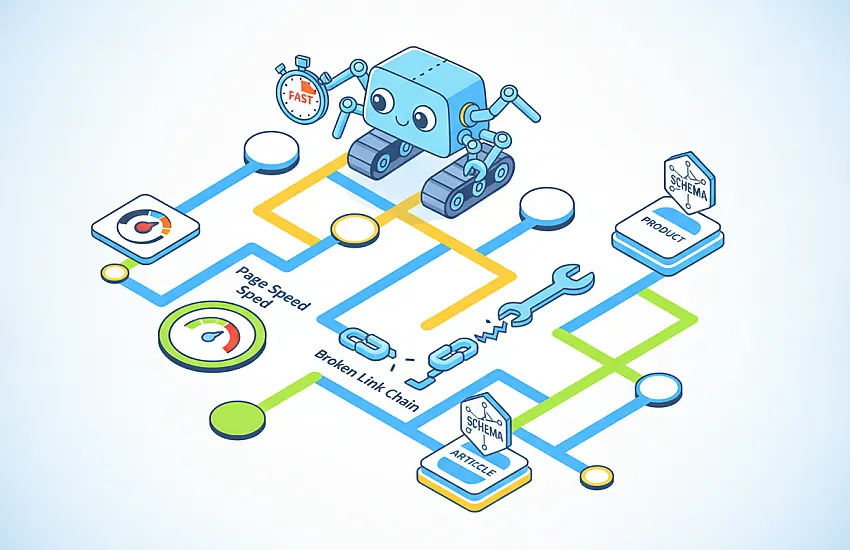
The third group is the mismatch between publication and rendering. If the template loads key elements late, hides some content or provides structural data poorly on the front end, editorial automation will help little. It's in logs and rendering tests that you see whether the pipeline ends with a genuinely processable document or just a correct entry in the CMS.
Do headless CMS and publishing via API actually improve SEO results, or do they only make the team's work easier?
They don't improve results by themselves. They can help or harm. From the SEO and AI Search perspective, the headless advantage is not in “modernity” but in control. If the organization wants to publish across multiple channels, maintain consistent entities and manage the structure of answers, an API-first architecture gives greater predictability than manual handling of several editors.
But this model only makes sense if someone watches over the rendered layer. Many headless implementations end up with a beautiful operational backend and a weak SEO layer: delayed rendering, missing metadata, breadcrumb problems, incomplete structured data or an unreadable heading hierarchy. The content team is then delighted with publishing speed, while organic performance and citationability stagnate.
If the system is to work for AI Search, you must look beyond the CMS itself. It matters whether it's easy to expose answer sections, FAQs, comparison tables, entity attributes, versioning of updates and schemas for different content types. For product categories it's also crucial that data is consistent between the product page, guides and category page, for example with oximeters and pulse meters. If these layers are disconnected, models receive an inconsistent picture of the domain.
In short: APIs and headless can provide an advantage, but only in the hands of a team that understands both publishing ops and the technical consequences for SEO.
How to prepare a pipeline for many markets and language versions so as not to create poor translations for AI Search?
The biggest mistake is copying the process 1:1 between markets. In international SEO that is already a problem, and in AI Search even more so. The same user question in different languages can have a different structure, different expectations of the answer and different dominant entities in results.
Therefore a multilingual pipeline should separate the universal layer from the local one. Universal elements can be: concept repository, shared quality standards, acceptance model, content types, technical publishing rules. Locally you need to build: intent research, PAA, typical problem phrases, sales questions, use cases and industry vocabulary.
In practice it's better to translate the brief than a finished article. A local editor receives the structure, entities and goals, but writes the material according to the market, not as a literal copy. This is especially important in commercial content, where language nuances affect conversion and credibility.
You also need to watch out for local differences in offering and naming. If the site operates internationally, you can't assume every category has identical communicative use across markets. Even internal linking must make sense locally, otherwise the user gets a logically correct but sales-wise dead content ecosystem.
Which structured data schemas really help with AI Search content, and which are just decoration?
First you need to sort one thing out: schema doesn't “turn on” presence in AI answers. There is no simple tag that will guarantee citation. Structured data helps when it organizes what is already well prepared editorially and technically.
In practice the most sense is made by schemas that support unambiguous content type and relationships between objects. For guides and expert materials it's usually important to correctly mark the article, the author, publication and update dates, breadcrumbs and FAQ elements where they truly answer user questions. For comparative content or product category pages consistency between the category page, product cards and related articles can be crucial.
The trap appears when the team starts “decorating” every page with more markers without caring about the source content. If FAQ schema describes questions that are barely developed on the page, or author data is sparse, the markup doesn't help. Sometimes it even hinders, because it declares a structure the user doesn't actually get.
The most sensible approach is conservative: fewer schema types, but implemented consistently and in line with the actual page format. Teams with lots of experience usually win through discipline, not the number of implemented tags.
How to tell that a company is ready for SEO automation for AI Search, and not just for testing tools?
Readiness doesn't depend on whether the organization has access to an AI model. It depends on processes. If the company doesn't have organized data sources, doesn't distinguish content types, can't identify the publication owner and can't assess content quality before deployment, automation will be just a faster route to greater chaos.
There are four practical signals of readiness. First, there is a shared source of truth for content: naming, offering, limitations, entities, mandatory publication elements. Second, the team can prioritize topics not only by volume but also by business value and alignment with intent. Third, it has a basic monitoring model covering not just traffic but also quality of visits and impact on the path to the offer. Fourth, it understands where humans must remain in the process.
If any of these elements is missing, it's better to start with a smaller pilot than a full rollout. This usually saves months of work. A well-conducted preparation phase may be less spectacular than generating hundreds of drafts, but it is precisely what distinguishes a system that supports sales and visibility from a system that produces only more URLs.
Most common mistakes in SEO automation for AI Search: what actually breaks the pipeline, publishing and monitoring
Most problems do not come from the technology itself, but from faulty implementation assumptions. Companies buy tools, assemble workflows from several integrations and assume that if the process "works", it will also start working for visibility, leads and citations in AI. Usually it doesn't. Below are the mistakes we most often see in real commercial implementations.
1. Automating chaos instead of the process
This is the most expensive mistake at the start. The team does not have a single source of truth for the offering, naming, entities, scopes of responsibility or quality criteria, yet they start generating briefs, drafts and publications. Why is this so common? Because automation gives the illusion of order. Statuses in the tool look professional, and the organizational problem is merely hidden.
Consequences appear quickly. Content is created based on different versions of data, two departments use different names for the same solution, and the editorial team doesn't know which information is approved. In AI Search this is particularly harmful, because models handle semantically coherent domains better than sites that contradict themselves. Google still rewards helpful, trustworthy content created with the user in mind, not only for ranking mechanics [1].
How to avoid this? First you need to tidy the operational layer: stage owners, a glossary, a repository of approved data and a minimum publication standard. Only then is it worth automating. In practice, a simple manually controlled pilot works much better for clients than an ambitious system launched on top of a mess.
From experience: if the question "where should the editor get the correct data for the content" is answered three different ways in a company, it's still too early for automation.
2. Treating the AI model as the final author, not a working layer
This mistake usually appears where there is strong pressure for scale. The company wants to publish faster, so it assumes the model will generate the text, the editor will just "take a look", and the CMS will do the rest. The problem is that models sound very good even when they simplify, fill in gaps or mix levels of intent.
This is common because the output looks convincing. Especially to people who are not deeply involved in content ops, technical SEO and AI Search. But a convincing tone does not mean correct content logic. In commercial materials the model often produces paragraphs that are too general, too broad or too certain in their reasoning. Then the team publishes a text that doesn't answer the user's specific question well, so it doesn't collect citations or support a purchasing decision.
What are the effects? In the best case time is wasted rewriting. In the worse case the number of mediocre URLs grows, which burdens the cluster and blurs topical authority. With specialist content there is also the risk of factual errors or overly categorical statements.
How to avoid this? Automate the brief, structure, question extraction, entity map, publication checklist and monitoring. Do not hand over the final expert layer without control. Well-organized teams don't ask: "will AI write the article?", but: "which steps will prepare better working material for the human?".
Practical takeaway from implementations: the more commercial the topic and the closer to BOFU, the more damage a "almost-good" published text causes.
3. Building the pipeline for volume, not for the content's business function
This mistake is typical for companies that look at automation through the number of monthly publications. The pipeline is designed to deliver as many URLs as possible, but not to solve specific user problems at the right stage of the decision process.
Why does this happen? Because volume is easy to measure. It's much harder to build a prioritization system based on intent, impact on the offering, chance of citation and role in the cluster. As a result, texts are created that generate some traffic, but poorly support service, product or sales pages.
The consequence is twofold. First, the team produces content with low operational value. Second, automation is incorrectly judged as ineffective because "there is traffic but no leads". Meanwhile the problem was not the pipeline itself, but its wrong input model.
How to avoid this? Each topic before entering the pipeline should be assigned a function: decision support, solution comparison, troubleshooting, answer to a purchasing objection, preparation for a sales conversation, updating an entity in the cluster. This organizes not only publication, but also later monitoring.
From practice: a backlog of 300 topics often shrinks by one third after an honest review. And that's good news, not bad.
4. Mixing several intents in one URL because "it's a shame to waste the topic"
This is a very common editorial reflex. The team has a commercial topic, so they try to fit a definition, comparison, selection checklist, implementation, FAQ and a sales fragment into one article. Formally the content is comprehensive. Operationally it becomes inconsistent.
Why does this mistake recur? Because many people still think in terms of "the fuller the article, the better". In AI Search it often works the opposite. Answer systems look for fragments that clearly solve a specific problem, not sections written for three different goals at once. Google AI Overviews build synthetic answers based on many sources and link to materials supporting a given answer [2]. If a URL doesn't have a dominant function, it's harder to become such a source.
Effects? Worse citability, weaker match to queries, greater risk of cannibalization with other materials and lower usefulness for the commercial user. Such a text tends to be "about everything", so it's not best at anything.
How to avoid this? Determine the main answer for each URL and guard the boundaries of the content. If an article is meant to help assess implementation, it should not broadly develop an operational section just because "it also fits". The rest should be split into separate materials and connected by linking.
Practical observation: the most damage is done not by entirely bad articles, but by good articles with three additional sections that shouldn't be there.
5. Publishing without validating the template and rendered layer
In many companies the pipeline ends when the post lands in the CMS. This is a serious mistake. From the SEO and AI Search point of view, publication does not end with saving the content, but with delivering a correctly rendered document with the proper structure, metadata, linking and supporting elements.
This problem is common because content and development work separately. The editorial team assumes that if everything looks good in the editor, robots and answer systems will see it correctly too. In practice, however, headings often drop out, author fields disappear, the update date is not saved correctly, schema is cleaned by the editor or a key section loads too late.
Consequences are brutal because they are hard to notice without tests. The team thinks it published a correct article, but in reality pushed out a document that is poorly processable. Then there is frustration that the content "should work", but it doesn't.
How to avoid this? Build mandatory post-publication validation into the pipeline: HTML render, headings, author tags, dates, breadcrumbs, structured data, canonical, indexability, answer sections and internal linking. With headless or API publishing this is not an addition. It's the core of quality control.
From experience: many problems blamed on "the algorithm" are simply a badly delivered publishing layer.
6. Mechanical internal linking generated by a rule, without intent control
Automating linking can be tempting. The system detects an entity or keyword and automatically attaches a link to a category or product. On paper it looks efficient. In practice it's very easy to break the logic of the user's path.
Why is this common? Because linking is seen as a technical element that can be easily automated. The problem is that in commercial content it's not the link itself that matters, but the timing and context of its use. If the system appends references just because it found a matching word, the text quickly starts to look like it was stitched together by a machine.
There are two effects. The user gets unnatural transitions, and the cluster begins to blur the roles of individual URLs. Sometimes we also see situations where several articles link to the same page with almost identical context, although only one of them should actually serve as the bridge to the offering.
How to avoid this error? Establish a linking policy based on intent type, funnel stage and the role of the material. Not every text should lead to a sales page. Some should lead to a comparison, some to an FAQ, some to a category. You can automate link suggestions, but approval should remain with a human or well-defined semantic rules.
From practice: if after implementing automation the number of links grows faster than the number of meaningful transitions to the next steps in the path, the system is linking too much or incorrectly.
7. No separate pipeline for updates, causing the site to bloat instead of mature
Many teams automate creating new topics but do not build a process for refreshing existing content. This is a very costly mistake. Especially where some materials already have history, links, indexing and partial visibility.
Why is this common? Because publishing a new URL is more spectacular. It's easier to show in a report. Updating older material seems less attractive, even though it often gives a better operational effect.
The consequence is simple: the number of contents grows, but their average quality and coherence decreases. Older URLs start answering outdated questions, conflict with new materials or stop supporting the current offering. This is particularly visible in product and how-to clusters at the same time.
How to avoid this problem? A separate workflow for refreshes. With its own scoring, triggers and success criteria. Signals for updates should include not only position drops, but also assortment changes, loss of snippets, decrease in transitions to offers, entity drift or the emergence of new sales questions.
Practical insight: for some clients the first meaningful AI Search wins did not come from new publications, but from rebuilding old materials that already had domain trust.
8. Measuring effectiveness only by rankings and organic sessions
This is one of the most misleading reporting mistakes. A company implements SEO automation for AI Search and then evaluates the whole system solely by positions for a few phrases and traffic growth. That's not enough, especially for commercial intent.
Why is this so common? Because classic metrics are known, easily available and convenient for management. The problem is that the generative answers environment changes user behavior. Some queries end without a click, some build an earlier stage of the decision, and some lead to a brand return over time. Google indicates that AI Overviews are meant to help the user understand the topic faster and direct them to sources for further exploration [2]. That means content impact is distributed differently than in a simple last-click model.
The consequences of wrong measurement are serious. Good content can be judged poor because it didn't produce an immediate lead. Meanwhile content with traffic but no business value gets undeserved priorities. In this way the pipeline learns bad decisions.
How to avoid this? Report multi-layered: presence in AI answers, transitions to offer pages, share of URLs in assisted paths, increase in brand queries, user returns, lead quality and the impact of content on sales conversations. For commercial topics this is much more important than the number of sessions alone.
From experience: when salespeople start hearing more advanced questions from leads, that's often an earlier signal of success than a visible jump in a classic SEO report.
9. Ignoring logs and crawl signals at large publishing scale
When the pipeline speeds up, many companies assume that more publications automatically mean faster effects. They don't. At larger scale it quickly becomes apparent whether the site is actually being effectively crawled and processed.
This is a common mistake because content and strategic SEO teams rarely work with log data. They limit themselves to Search Console. That's useful but insufficient. With automated publishing you need to know how quickly bots visit new URLs, whether the crawl budget goes to low-value addresses and whether new content is embedded too shallowly in the site's architecture.
Consequences? The pipeline produces faster than the domain can realistically consume it. Some content waits a long time for the first crawl, some is poorly supported by linking, and the team misinterprets a lack of results as a content quality problem.
How to prevent this? Add a minimal set of technical signals to monitoring: time from publication to first bot visit, frequency of visits to new URLs, share of low-value addresses in the crawl, sitemap correctness and content embedding in the cluster. This doesn't have to be a big weekly audit. Regular trend checks are enough.
Practical observation: if a site publishes a lot but new materials do not get meaningful crawl, the problem usually lies in the architecture or technical prioritization, not the content itself.
10. Copying the same process to every market and language
Companies developing content for several markets often assume that if the pipeline works in one language, it's enough to translate it. That's a mistake. In AI Search differences between markets show up even more strongly than in classic SEO.
Why is this so common? Because centralizing the process seems economical and orderly. But user questions, dominant entities, expected answer length and the way commercial intent is phrased differ between markets. The same topic can have a different sales function in another language.
The effects are predictable: translations sound correct but miss local intent. The content can be logical yet commercially dead. AI models are also reluctant to cite materials that look like a structural copy from another market.
How to avoid this? Maintain a shared layer of standards, but localize intent research, user questions, editorial angle, supporting entities and linking. In practice it's much better to translate the brief than a finished article. A local editor should write for the market, not for a central template.
From experience: the biggest losses come not from poor linguistic translations, but from grammatically correct texts that don't match the local way of asking questions.
11. Too broad an implementation from the start, without a limited pilot
This is an ambition mistake. The company wants to automate the entire blog, help section, landing pages, category descriptions and monitoring in several AI tools at once. It sounds impressive, but in practice it makes it hard to find the real causes of problems.
Why is this common? Because teams want to quickly prove an effect. The problem is that a large implementation masks dependencies. Later it's unclear whether scoring, validation, CMS, linking or the briefing model is not working.
Consequences are predictable: chaos in the backlog, acceptance bottlenecks, lack of trust in the process and a large number of contents that no one knows how to sensibly evaluate. Then management hears that "AI for SEO didn't work", although the implementation method actually failed.
How to avoid this? Start with a narrow cluster, one content type and a limited sample of queries for monitoring. Preferably where commercial intent is clear and input data is relatively ordered. Only after stabilizing the process should you expand the scope.
Practical takeaway: a good pilot should be small enough to detect errors, but significant enough that after its success it's easy to justify scaling the process within the organization.
12. Shifting responsibility for quality to the "tool"
This is more of a managerial than a technical problem, but very common. When results are poor, the generator, CMS, integration or model becomes to blame. Meanwhile most failures stem from lack of an owner of quality at the intersection of SEO, editorial, product and publishing.
This mistake occurs because automation disperses responsibility. Everyone did their part: someone prepared the prompt, someone the integration, someone the publication, someone the report. And nobody is accountable for the final usefulness of the content as an element of visibility and sales system.
Result? The pipeline works technically but does not improve results. The organization has a process that no one really runs. This is more common than it seems.
How to prevent this? Appoint a process owner, not just stage owners. That person must see the whole chain: from topic input to impact monitoring. Without that it's very hard to decide what to fix first.
From practice: the best implementations are not the most automated ones, but those where it's clear who has the right to say "we won't publish this because it doesn't meet the business role".
If I had to identify a common denominator of these mistakes, it would be simple: companies too often confuse publishing speed with operational maturity. And in SEO automation for AI Search scale alone does not provide advantage. Control over intent, structure, coherence and measurement of effect does.
Myths about SEO automation for AI Search that most often ruin implementations
There are many simplifications surrounding SEO automation for search engines and answer engines. Some come from tool presentations, some from observing individual cases, and some simply from confusing rapid production with a mature process. Below are beliefs that regularly lead companies to poor operational decisions, especially when the goal is not just traffic but leads, sales and presence in AI answers.
Myth 1: “If a pipeline publishes content, Google and AI models will more quickly deem the domain expert”
This belief usually stems from a simple association: more published material = more visibility = greater authority. The problem is that topical authority does not arise from the sheer number of URLs. It emerges when a domain consistently closes out a topic from different angles, maintaining consistency of entities, language and coverage of user questions.
The falsehood of this myth is especially visible with sites that start publishing broadly but without scope control. From the outside it looks impressive: lots of new posts, new clusters, regularity. In practice some materials begin to repeat, some answer similar questions with different words, and some exist only because the tool suggested another variant of the topic. That doesn’t strengthen the domain. It dilutes it.
The market reality is more demanding. Search and answer systems better understand sites that have logically built topic coverage and clear relationships between content, not just a large volume of publications. Google still points out that the priority remains content that is helpful and created with users in mind, not purely for ranking mechanics [1].
From practice: when I see a site that in three months published 150 articles about “AI SEO”, “SEO AI”, “AI in SEO”, “content automation” and “writing with AI”, I usually don’t see an advantage. I see a problem with topic boundaries. Much better is 20–30 thoroughly developed pieces that really organize the area and lead the user further.
Myth 2: “You must build full end-to-end automation first, otherwise it makes no sense”
This myth is popular especially in tech companies and among people who like to think in processes. The source is understandable: if you’re going to automate something, it’s best to automate the whole chain at once. From research to publication and reporting. It sounds logical, but in practice it can be harmful.
The problem is that full automation from the start makes it hard to see where the real limitations are. If you connect topic sources, scoring, draft generation, CMS integration, linking and monitoring all at once, after a month you no longer know whether the issue is failing prioritization logic, input quality, the publication template, or the editorial layer itself.
In reality layered implementations work best. First stabilize the part of the process with the biggest impact on commercial results, then attach the next elements. That model is less impressive on a diagram but gives better control. This is especially important where content is meant to support purchase journeys, not just build informational traffic.
Practical observation: mature teams very rarely start with a “full autopilot.” They usually begin with one cluster, one page type and one monitoring logic. Not because they can’t scale faster. Because they want to know what really works before increasing the scale.
Myth 3: “AI Search favors big brands, so smaller companies have no real chance of being cited”
This is a convenient excuse because it lets you shift responsibility to the market. If mostly large domains are cited, a smaller player may conclude there’s no point in competing. The source of this belief is observing broad queries where strong media, well-known brands or high-reach sites often dominate.
However, that’s only part of the picture. For more specific, operational and comparative queries the advantage is often won not by the biggest brand but by the source that answers more precisely and usefully. Google AI Overviews create summaries based on many sources and direct the user to supporting materials [2]. That means it’s not only domain strength that matters, but also the usefulness of a particular content fragment in the given context.
In practice smaller sites usually lose not because they’re smaller, but because they try to copy big players’ strategy: broad guides, general articles, cautious content without a clear angle. Meanwhile their advantage could lie in narrower questions, better process descriptions, breaking down nuances or more precise industry language.
From experience: in niche topics the winner is more often the domain that can dissect the problem well than the domain that simply “has reach.” Citability isn’t democratic, but it’s not reserved exclusively for the largest either.
Myth 4: “Content for AI Search should be as neutral and general as possible to fit more prompts”
This belief is a result of excessive caution. Teams fear that overly specific material will limit reach, so they smooth language, remove nuances and write to “exclude nobody.” The effect is often the opposite.
Overly neutral content is often not very useful. It doesn’t decide, it doesn’t compare sensibly, it doesn’t show decision conditions, it doesn’t say when a given approach makes sense and when it doesn’t. For a commercial user that’s too little. For an answer engine as well, because such material is harder to use as a source for a concrete answer.
The industry reality is that conditional, practice-embedded content works best. Not “it depends” as an evasion, but “it depends on X, Y and Z; in this scenario you do this, in another you don’t.” That writing style is more useful and also more credible. It also helps distinguish expert content from a safe compilation.
In commercial projects I see this constantly: overly cautious texts are readily accepted internally, but perform poorly externally. The company thinks they are “professional,” but for the audience they are simply unhelpful.
Myth 5: “In automation the text-generating model is the most important; the rest are extras”
This myth sells tools well but poorly describes real operational work. It comes from focusing on the most spectacular element of the process. A finished draft in a few minutes is impressive. Proper entity mapping, field validation, status handling, version control or an update system are not.
But it’s precisely these less flashy elements that decide whether the process is business-useful. Even a very good model won’t fix wrong cluster logic, poor routing of content to intent, lack of publication standards or inconsistent input data. In many companies the bottleneck is not content generation, but passing it on without losing quality and context.
Industry practice is brutal: the best model in a bad workflow produces drafts that need correction faster. An average model in a well-set-up process often yields a better final result because the team knows what to do with it, how to constrain it and where human intervention is needed.
In implementation experience the biggest quality improvement usually comes not from changing the model but from changing the entry and exit rules. In other words: less fascination with generation, more process discipline.
Myth 6: “If a brand is cited by AI, clicks stop mattering”
The source of this myth is simple: fears about zero-click search are growing, so some companies regard mere presence in the answer as the new main goal. That view is too flat. Being cited has value, but not every synthetic visibility translates to business results.
First, brand presence in an answer can serve different functions. Sometimes it builds recognition. Sometimes it supports an earlier decision stage. Sometimes it actually leads to a site visit. Without distinguishing these scenarios it’s easy to overvalue simply being shown as a source.
Second, some generative queries shorten the path to knowledge but don’t eliminate the need to visit the site where users want to compare, verify details or go to an offer. Google communicates that AI Overviews are meant to help users understand a topic and direct them to further sources [2]. This is not a “visibility instead of traffic” model, but rather “visibility before and around the click.”
The practical conclusion is simple: do not oppose citability and traffic. Look at which query types presence in AI supports later transitions, increased branded queries, user returns or visits to offer pages. Otherwise a report becomes pretty but commercially useless.
Myth 7: “AI Search monitoring can be based on one fixed set of prompts and you can draw hard conclusions from that”
This is a common methodological error. Since classic SEO accustomed the market to phrase tracking, many teams try to transfer that logic one-to-one to the generative answers environment. The idea seems reasonable: choose prompts, check answers and measure domain presence.
The problem is that such an approach can be overconfident. Model answers depend on context, history, question variant, system updates and the prompt’s construction itself. The same question intent can be expressed in several ways, and the result may not look identical. Searching for a “fixed position” in such an environment leads to illusory precision.
The reality is different: AI Search monitoring should be based on intent groups, question variants and observing presence trends, not on the belief that one prompt will represent an entire category. This requires more analytical work but gives a much better picture. Otherwise a company may think it has “dropped” when only the tool’s way of formulating answers has changed.
From practice: sensible AI Search monitoring resembles more a study of thematic exposure than classic rank tracking. Anyone trying to make a simple table of positions from this usually quickly falls into false alarms.
Myth 8: “Automated content should immediately be universal for SEO, sales, onboarding and support”
This myth comes from good intentions: if a company already invests in the process, it wants to use content across departments. The direction itself is not bad. The mistake occurs when one publication is supposed to simultaneously drive traffic, close sales objections, explain implementation and serve as documentation.
Such material usually loses sharpness. From the SEO and AI Search perspective it starts to mix functions, and from the user’s perspective it’s unclear who it is really for. Content that is “for everyone” is very often not good enough for anyone specific.
In practice mature organizations do something different: they use a shared knowledge base but separate end products. One piece supports a commercial query, another helps the salesperson, another is a customer FAQ, and another is implementation documentation. This is not wasting a resource. It’s protecting intent.
From experience: the biggest mess appears where marketing wants “one article that covers everything.” The greatest effectiveness appears where the company understands that one knowledge source can yield several formats but should not end in a single overloaded URL.
Myth 9: “When automating, it’s best to limit experts’ involvement because they slow the process down”
This belief regularly appears after initial approval bottlenecks. Since experts correct, comment, send drafts back and lengthen publication times, some organizations conclude they must “detach” them from the process. In the short term this may speed up output. In the long term it usually harms.
Not because every text must go through a senior review. The problem lies elsewhere: expert knowledge should not disappear from the process but be better embedded in it. If a specialist’s role is to read the entire article start to finish, the process will indeed be heavy. But if the expert approves rules, exceptions, critical fragments and borderline language, their involvement becomes much more effective.
Market practice shows clearly: sites that cut the expert layer too much quickly start to sound like hundreds of others. That may be enough for simple topics but performs poorly for content that must convince a user with a real problem or be used as a credible source.
Practical insight: an expert doesn’t have to be an editor, but should co-create the rules that editorial and automation follow. Without that, the process accelerates mainly the production of average content.
Myth 10: “SEO automation for AI Search is mainly a solution for software and SaaS, not for specialized industries”
This stereotype persists for a long time in organizations from regulated, technical or product sectors. Since the topic is complex and the risk of error high, automation seems foreign or even dangerous. The source is understandable, but the conclusion goes too far.
Automation doesn’t have to mean automatically writing everything. In specialized industries it usually makes most sense where it organizes the operational layer: topic classification, briefs, updates, information versioning, publication checklists and change monitoring. The more difficult the industry, the greater the value of a well-configured process control.
It’s precisely in such areas that it’s particularly worthwhile to distinguish stable information from what needs approval. Some can be processed broadly, others must be flagged and routed through a tighter workflow. This is a much more mature approach than rejecting automation simply because the area is demanding.
From implementation experience: specialized industries rarely need “more AI.” They more often need better rules for using AI. And it’s precisely there that a correctly configured pipeline can give the biggest advantage, because competitors usually operate slower and more manually.
Myth 11: “If content is good, cluster architecture is of secondary importance”
This is an editorial myth. It comes from the belief that the quality of a single piece of content will defend itself. Sometimes that happens with a very strong, unique article. At the process level that assumption is risky.
In AI Search and SEO a single URL increasingly rarely works alone. What matters is how content is embedded in the whole thematic structure: where it leads, what it follows from, what questions it closes, what it doesn’t duplicate and which entities it strengthens alongside others. Even a good article may not realize its potential if it lives in a poor semantic neighborhood.
The operational reality is that the pipeline should guard not only publication quality but also the publication’s role. Is it an entry material to the cluster? A bridge to an offer page? An answer to an objection? An update of a semantic gap? Without this the site grows but doesn’t mature.
In practice companies lose many opportunities here: they have decent content but no discipline in assigning it functions within the cluster. Then even correct publication doesn’t build as strong an advantage as it could.
Myth 12: “Automation is cost-effective only at a very large scale of publications”
This is a common belief in mid-sized companies. If they don’t publish hundreds of articles per month, they assume pipelines, automatic briefs or multi-layer monitoring are “for later.” The source of this thinking is identifying automation solely with production scale.
That’s an incomplete picture. Automation also makes sense at a smaller scale if it reduces the cost of mistakes, shortens transition time between stages, organizes updates or improves topic accuracy. For commercial firms often more important than the number of publications is not wasting the team’s time on manually repeating the same tasks and repeatedly sending materials back.
Industry reality shows that even with a few publications per month you can sensibly automate scoring, briefing, checklists, update alerts or assessing content impact on the path to an offer. It doesn’t have to be a complex system. It should simply remove repetitive friction.
From experience: those who gain the most are not always those who publish the most, but those who most quickly eliminate unnecessary handoffs, corrections and misunderstandings between SEO, content, sales and the subject-matter expert.
If there is one common lesson from these myths, it is a tough one: SEO automation for AI Search does not reward process naivety. The more a company simplifies the topic to the slogan “more content faster,” the more often it ends up with an expensive system that looks good in the tool but performs poorly on visibility, citability and commercial results.
Comparison of approaches to SEO automation for AI Search: what really works in pipelines, publishing and monitoring
With commercial intent the question is usually no longer "whether to automate", but "how to arrange it so the process yields predictable results and does not create quality debt". The differences between approaches are large, especially when content must at the same time drive organic traffic, transitions to offers and presence in answers generated by search engines and AI models.
There is no simple split below into "good" and "bad" solutions. In practice almost any approach can make sense if it is matched to the scale of the site, the maturity of the team and the level of substantive risk. The problem begins when a company implements a model that is inadequate for its own organization.
1. Full automated publishing vs pipeline controlled with editorial oversight
Fully automated publishing means the system picks a topic, generates a draft or a finished piece, fills in metadata and pushes the content to the CMS with virtually no human involvement. This model can be tempting in large affiliate sites, simple content projects and where rapid coverage of a huge number of long tails matters.
Controlled pipeline works differently. Automation covers research, topic scoring, briefs, structural elements, publishing fields and monitoring, but the final substantive layer, the decision on editorial angle and the approval to publish remain with the team. This solution is more common in B2B, SaaS, specialized e-commerce and regulated industries.
The practical difference is significant. With full automation you can increase the number of URLs faster, but it is harder to maintain entity consistency, correctness of industry nuances and sensible alignment with commercial intent. With a controlled model the pace is often slower, but it's easier to create content that actually supports purchase decisions rather than just collecting incidental traffic.
Who is the first variant for? For organizations that publish simple, low-risk content and can accept a higher share of materials that will need later correction. Who is the second for? For companies that sell solutions requiring trust, comparisons, precision and a sensible transition from content to offer.
The limitation of full automation is particularly visible where a single inaccuracy can weaken the credibility of an entire cluster. This applies for example to content related to specialist categories such as EKG electrodes or Holters, where the user does not expect generalities but a precise answer grounded in application.
From market experience: companies most often overestimate the benefit of the automatic "push" to the CMS and underestimate the value of editorial control checkpoints. Publishing faster rarely gives an advantage if the pipeline cannot filter out topics that are weak from a business perspective.
2. Automation based on ready-made no-code tools vs solution tailored to your own process
No-code stack usually relies on connecting a few services: a sheet or database, a brief generator, a workflow integrator and a CMS. This approach allows you to quickly build a working prototype without engaging large technical resources. It works well for pilots, cluster tests and teams that want to validate the process before deeply integrating it.
Custom solution tailored to the process makes sense when content is only one element of a larger system: product data, CRM, approval statuses, multilingual publishing logic, proprietary topic scoring or monitoring of many types of visibility. In this model the organization builds a panel or an intermediary layer under its own working rules.
The most important practical difference concerns flexibility. No-code is faster to start and easier to change in the first weeks. However, as the process matures limitations begin to appear: harder versioning, weaker exception control, higher risk of data divergence between tools. A solution tailored to the process starts slower but withstands larger scale and more complex editorial decisions better.
Who benefits from no-code? In-house teams and agencies that want to launch a quick proof of concept, test topic scoring or implement simple automation without waiting for development. Who should consider a custom layer? Organizations with mature content ops, many data owners and a strong need for publication quality.
The limitation of ready-made integrations usually reveals itself not in content generation but in exceptions: separate rules for categories, different acceptance levels for topic types, nonstandard schema fields or monitoring dependent on intent type. When such exceptions increase, no-code ceases to be simple.
Industry observation is repetitive: many companies invest in their own system too early, before proving that the operating model itself is correct. A more sensible path usually looks like this: first no-code and a pilot on one cluster, then only customize what actually becomes the bottleneck.
3. One central pipeline for the whole site vs separate pipelines for content types
One central pipeline provides organizational order. All topics go through the same scoring, similar statuses, uniform publication rules and a common dashboard. It's convenient for reporting and helps build a consistent editorial standard.
Separate pipelines for content types split the process, for example into guides, service pages, comparisons, updates to existing materials and strictly product content. This way each group can have its own quality criteria, its own acceptance level and separate monitoring logic.
The practical difference is important: the central pipeline tidies work, but it easily starts treating all topics as similar tasks. That works for simple blogs. It is worse where an implementation comparison, a BOFU landing and an update to an older article have completely different business functions. Separate workflows increase operational complexity but usually better reflect the site's realities.
A unified model is good for small and medium projects that are only building regularity. Split pipelines are better for larger domains and companies that already know different rules should apply for educational content and different ones for materials supporting sales of specific categories, such as oximeters and pulse meters or blood pressure measurement.
The limitation of the separate pipelines model is obvious: the number of exceptions, statuses and responsibilities grows. If the team has no process owner, it is easy to make a system hard to maintain. Conversely, the limitation of a single pipeline is excessive simplification. On paper everything looks neat, but the quality of editorial decisions falls.
In practice the intermediate solution works best: one core process and separate rules for selected formats. It's less elegant than full centralization or full segmentation, but usually the most useful.
4. Generating finished articles vs generating briefs and working drafts
Generating finished articles can be justified where content has a simple template, a low threshold of specialization and a predictable structure. In such cases the model can save a lot of time, especially if the final edit is light.
Generating briefs and working drafts moves the AI role to an earlier stage. The system prepares structure, questions, entities, proposed sections, linking and elements for validation, but does not pretend to be the final expert. A human builds real value on that skeleton.
From the market perspective the second model performs much better in commercial content. Not because AI "can't write", but because BOFU and MOFU require accurate emphasis on limitations, differences between scenarios, implementation caveats and consequences of a choice. These are precisely the elements most easily lost in mass-generated text.
Finished articles are good for content sites based on scale and low per-URL value. Briefs and working drafts are better for companies that want to combine SEO with a consultative sales approach. Especially when the text should prepare the user for a conversation with a salesperson or to evaluate several solution variants.
The limitation of the brief model is that it requires an efficient editorial team. If the company has no one to refine the content, even a good brief will not deliver quality. The limitation of the full-article model is more insidious: it seemingly saves time, but much of that gain is later consumed by editing, merging duplicate intents and organizing the cluster.
From practice: if an organization sells a complex service or a specialized assortment, investment in a better brief pays off faster than in a "magic" generator of final articles.
5. Publishing directly in the CMS vs publishing through an intermediary layer
Publishing directly in the CMS is simpler organizationally. An editor or automation saves the content directly where it will appear. It's fast and convenient, especially in small teams with a simple content template.
Intermediary layer means an additional step: an operations panel, a status database or your own approval environment, from which only selected fields go to the CMS. This slows down a single publication but improves control over the whole.
The most important difference concerns the quality of repetitive elements. In the CMS it's easy to publish quickly but also easy to overlook inconsistent headings, missing author, wrong schema type, unfinished linking or mistakes in technical fields. An intermediary layer reduces these problems because it enforces standards before content goes to production.
The direct model makes sense in simple sites where the number of publications is moderate and the team knows the CMS limitations well. The intermediary layer works better at larger scale, with multiple people publishing and where content must be monitored as part of a broader pipeline.
The drawback of an intermediary layer is more steps and the need to maintain an additional environment. If the process is poorly designed, such a panel starts to live its own life and becomes a second CMS that nobody likes. The drawback of direct publishing, on the other hand, is high dependence on people's discipline. Over the long term this is usually riskier than it seems.
On the market a hybrid solution often wins: the editorial team works in the intermediary layer, but the CMS receives only ordered, approved fields. This reduces errors without building an overly heavy process.
6. Classic SEO monitoring vs SEO + AI Search + business impact monitoring
Classic monitoring is mainly based on rankings, clicks, organic sessions, indexing and possibly CTR. This model is still needed, but with AI Search it does not show the full picture.
Extended monitoring additionally includes presence in AI Overview, mentions and citations in answer engines, the share of content in assisted paths, entries to offer pages, lead quality and the behavior of specific topic clusters after publication.
The practical difference is fundamental. In a classic report some content may look mediocre because it does not generate much traffic. In the extended model it turns out the same material often leads users to service pages or appears for queries that build later brand demand. With AI Search such content can be the most valuable.
Classic monitoring is sufficient for small companies at an early stage, when the goal is to build basic visibility and check whether the site is growing at all. Extended monitoring is needed where content must justify sales, support the sales team and build the domain's share in generative answers.
The limitation of the extended model is one: it's harder to report and interpret. Data from AI tools are less stable than organic positions, so it's easy to overreact to single changes. The limitation of classic monitoring is even more serious — you can make bad strategic decisions because you don't see the real role of content in the purchase path.
Practical insight from implementations: the more expensive and complex the offering, the less useful it is to look only at organic sessions. In such projects observing the impact of content on query maturation works better than a simple assessment "this article has many visits, so it's good".
7. Internal content ops team vs agency/specialized implementation partner
Internal team has the advantage in product knowledge, pace of offer changes and sales context. It also better understands which user questions actually repeat in sales conversations and which only look good in SEO tools.
External partner usually brings faster implementation pace, comparison of many working models and lower risk of building the process by trial and error. Good partners also have a broader perspective on how Google, AI Overview and answer engines react to different content structures.
The practical difference is not about "who writes better". It's about who can maintain the process. The in-house team better ensures continuity and updates. The external partner more quickly organizes the backlog, designs scoring and builds a quality framework.
The internal model is best where content is tightly tied to domain knowledge and requires regular changes. The agency or partner model works for building the process from scratch, auditing current activities, piloting a cluster or when the company lacks a senior SEO/GEO layer.
The limitation of in-house is typical: the organization knows itself too well and sometimes does not see where the process actually loses efficiency. The limitation of an external partner is different: even a good contractor cannot replace access to real product knowledge and current signals from sales.
The most mature arrangement is usually not choosing one camp, but a sensible division of roles. The partner designs the model, priorities and pipeline mechanics, and the internal team feeds it with knowledge, approvals and market feedback. That's where content that not only ranks but also genuinely supports sales most often emerges.
8. "We write broad hubs" approach vs "we build content for specific decision questions" approach
Broad topical hubs make sense when a company wants to build authority around a large entity and own a topic from a general perspective. They work well as a cluster axis, an entry point for linking and a place that organizes many side issues.
Content for specific decision questions is more targeted: comparisons, decision scenarios, implementation limitations, typical mistakes, purchasing checklists. These more often capture users with intent closer to a sales conversation.
In AI Search the second model often has the advantage because it's easier to extract a single, useful answer from it. A broad hub builds context and topical authority but is not always the best candidate to be quoted for a specific question. Targeted materials can be more conversion-oriented, but without a strong cluster around them the domain less effectively defends topic credibility.
Hubs are good for brands building long-term presence and semantic order. Decision-oriented content is better for companies that want to work faster on leads and transitions to offers. In practice one without the other rarely gives the full effect.
The limitation of hubs is that it's easy to fall into "encyclopedic" content — broad but not operational. The limitation of targeted materials is different: without central cluster logic they quickly duplicate and compete for similar intents.
From industry observation: companies with commercial intent usually have too many broad materials and too few pieces answering the questions the user asks right before shortlisting providers.
Which approach to choose in practice?
If a company is only starting to organize SEO automation for AI Search, the safest model is an intermediate one: no-code or a light operations layer, generating briefs instead of finished publications, editorial control, separate rules for commercial content and monitoring that goes beyond rankings. This is not the most spectacular solution, but it most often gives the best ratio of predictability to scale.
Full automation makes sense mainly where the cost of an error is low and the site earns from broad topic coverage. In B2B, expert and sales-sensitive environments a controlled automation works better because it allows building content useful not only for Google but also for answer systems and the sales team.
The main difference between a mature and an immature implementation is not the number of integrations. It's whether the organization understands the consequences of choosing its model. Some companies need speed. Others need control. Most need both — just in different proportions.
What few people say about automating SEO for AI Search
The most misleading thing in this area is that many pipelines look good in demos but perform poorly after three months of operation. Not because the technology fails. Usually because real problems only appear when automation intersects with editorial, sales, the CMS, updates, and accountability for mistakes. These are things few people show during the implementation sales stage, because the story about scale sounds much better than one about operational friction.
1. The biggest bottleneck is not content generation, but the acceptance of "almost-ready" content
In practice many teams assume that if AI prepares a draft to 80–90%, the rest will go quickly. The thing is, those "last 10%" take the most time. These are not cosmetic fixes. This is usually the moment when you have to decide whether the text actually matches the commercial intent or just sounds plausible. Most companies don't talk about this because at the implementation stage it's easier to sell the vision of acceleration than to admit that editorial will spend a lot of time making hard borderline decisions.
The effect is simple: the backlog formally shifts, but the team's real throughput does not increase proportionally to the number of generated pieces. From experience this is one of the most common points of frustration after rollout. The organization thinks the problem is the model or the prompt. Meanwhile the problem is that the pipeline produces too much material that requires editorial judgment that can't be sensibly automated.
In practice the best-performing companies are not those that generate the most drafts, but those that teach the system early to reject topics and sketches that are average from a business perspective. It's less flashy, but much more mature operationally.
2. "Automatic publication" often means errors become systemic rather than incidental
With manual work a single editorial mistake is simply a mistake in one piece. With automation the same error can pass through dozens of URLs. Few emphasize this difference because companies like to think of automation as eliminating human risk. In real content ops automation does not remove risk. It changes its character. Instead of ten small mistakes you have one misconfigured element that breaks an entire cluster.
The consequences are more serious than usually assumed. If a pipeline mis-maps the intent type, misstates the roles of sections, or assigns publication fields incorrectly, you do not get one weaker article. You get a series of pieces with the same structural flaw. Then the team spends a long time wondering why the materials "are correct" yet fail to become strong sources for generative answers or to support conversions to offers.
From a practical perspective that's why small publication batches and regular reviews of error patterns are so important. It's not about controlling a single text, but about catching errors replicated by the process itself.
3. In AI Search the winner is often not the best article, but the most "extractable" fragment
This is one of the less intuitive things. In classic SEO thinking you evaluate the whole URL. In practice generative answers very often consume content in fragments. That means a great substantive piece can lose to a weaker overall text that is better broken down into clear answer blocks. Few people say this directly because it undermines the simple narrative that it's enough to "write the best article on the internet".
The consequence for the pipeline is pretty brutal: some teams invest a lot of work in elaborate, impressive materials that are hard to synthesize. Then they are surprised that citation rates are mediocre. In practice for commercial content sections with a clear scope of answers, a clearly stated problem, and business consequences work much better than long, broad discourses.
In day-to-day work this is very evident in implementation and comparison topics. A piece can be expert, but if the answer to the key question is hidden among digressions, the answer system will choose another source.
4. The hardest part is not building the pipeline, but maintaining a shared entity language across teams
On paper everything looks simple: SEO does research, content prepares the copy, product provides knowledge, and development supports publication. In practice each department uses a slightly different language. Some talk about features, others about use cases, a third about modules, a fourth about customer problems. Most companies don't talk about this openly because it doesn't look like a technical issue, yet it often underlies the whole implementation.
If the pipeline lacks a maintained conceptual layer, very costly divergences begin. Content is locally correct, but the whole site doesn't build a single, coherent picture of the topic. For the average user this may still be tolerable. For systems that assemble answers from many semantic signals, such inconsistency is far more harmful.
From experience this shows up especially in companies that grow fast or have several people providing expert knowledge. Without a central vocabulary the automation starts multiplying different variants of the same meaning. Then you have to clean up not single texts, but entire clusters.
5. AI Search monitoring can be misleading because many teams look at too short a horizon
This is a topic rarely discussed honestly. Tools for monitoring presence in AI answers are useful, but they also give an illusion of precision. In practice results can change faster than classic rankings, and single observations are easy to overvalue. Most vendors and implementers don't emphasize this enough because a dashboard with daily changes looks attractive.
The practical consequence is that teams start reacting to noise instead of trends. They rebuild sections after a short dip in answer visibility, change structure after a single test, and destabilize material that simply needed time. From my observation many unnecessary changes stem from overinterpreting unstable signals.
In practice it only makes sense to combine several layers: classic SEO, answer presence, conversions to offer pages, and changes in the quality of commercial queries. Only such a set shows whether the content has truly started to work. Fluctuations in "citability" alone can be very deceptive.
6. Updating the pipeline is often harder than deploying it
At launch most energy goes into starting the process. The problem appears later, when category models change, the product structure shifts, tagging methods evolve, or brief logic changes. Many companies do not anticipate that a content pipeline also has its own technical and editorial debt. People don't like to talk about it because deployment should look like a closed project, not a system that requires continuous maintenance.
The consequences are fairly typical. For the first weeks everything runs smoothly, and then exceptions begin to accumulate around the process. Special rules for selected formats are added, separate approval paths, nonstandard fields and manual workarounds. After a few months the team has a pipeline that is formally automated but operationally increasingly depends on the knowledge of two people "who know how to bypass it".
This is the moment when automation stops scaling and starts generating hidden maintenance costs. In practice you see it not in the number of publications, but in the time needed to implement a new rule or fix one variable across the system.
7. The most underrated problem is the conflict between the need for standardization and the need for "human unevenness" in content
Companies want a pipeline that ensures repeatability. Rightly so. The problem is that too uniform content quickly begins to look like a product of a single template. Few will say this outright because standardization is one of the main arguments for automation. However in AI Search and commercial content repeatability can be risky not only stylistically but also substantively.
If every piece responds according to the same rhythm, with similar section logic and identical argumentation, the domain starts to sound predictable. That reduces usefulness for the user and limits the content's ability to capture different variants of questions. In practice this is very visible in comparison clusters, where a too rigid structure kills decision-making nuances.
From experience the best pipelines standardize control elements, not the thinking behind the text. A template should guard quality, not force every article into the same voice and identical argumentative path.
8. In commercial SEO for AI Search "safe" content often loses, not weak content
This is an uncomfortable truth. Many companies publish correct, orderly, and brief-compliant materials that are too cautious. Without a stronger stance, without showing limitations, without indicating when an approach doesn't make sense. Why do few talk about this? Because safe content passes internal acceptance more easily and rarely provokes resistance from sales or product teams.
The problem is that such materials are rarely remembered as a source of a sensible answer. They are correct but interchangeable. In practice citability and sales impact are more often built by content that can show the consequences of a choice, implementation limitations, and the real differences between approaches. Not through controversy, but through concreteness.
This is especially evident for topics where the user is close to a shortlist of vendors. At that stage they are no longer looking for a neutral description of the process. They want material that helps them make a decision without guessing.
9. Commerce and customer service data are usually much more valuable than companies think, but very hard to integrate into the pipeline
Many organizations declare they want to connect content with real customer questions. In practice few do this well. The reason is prosaic: sales data is unstructured, full of shorthand and recorded in conversational language rather than content language. Few mention this because the idea "we use the voice of the customer" sounds great. The daily work of cleansing these signals looks much worse.
The consequence is that many pipelines rely mainly on SEO tool data and much less on the questions that truly block a purchasing decision. Then content captures the topic well but works worse for lead generation. This is not a problem of research as such. It's a problem that the organization cannot translate sales language into a useful input for content ops.
In practice the most value comes not from full transcripts of conversations, but from well-tagged recurring objections, implementation conditions, and comparative questions. Only then does automation have sensible fuel to consume.
10. The best results often come not from new publications but from rebuilding materials that already have topical trust
This can be disappointing for teams focused on scale because a new pipeline is associated with new production. In practice the biggest effect often comes from rebuilding existing content so it's more useful for synthetic answers and better at leading to offer pages. Few emphasize this because it's harder to sell as a spectacular innovation.
The business consequence is significant. An organization that ignores older assets often produces more URLs even though the greatest potential lies in materials already embedded in the domain. Such content has history, links, indexing, and a certain level of trust. If well rebuilt, it can gain traction faster than fresh publications starting from zero. Google emphasizes that ranking systems should promote helpful, reliable content created for users [1], and AI Overviews point to sources that support further exploration of a topic [2]. In practice this means that organized and well-updated material often has a better chance to become a useful source than a new piece written only to cover a phrase.
In many implementations this is where the first real return appears: not in bulk publication, but in a smart reconstruction of what the domain already has.
11. Clients usually hear about time savings, and less often about higher demands on senior staff
This is one of the more unspoken issues. Automation does remove some operational work, but it also raises the importance of people who can assess topics, improve text logic, spot substantive risks, and connect content with business goals. In other words: simpler work decreases and experience-driven work increases. Few companies talk about this openly because it's easier to talk about easing the team's burden than about the competency shift across the process.
The practical effect is clear. If the organization lacks a senior decision-making layer, the pipeline begins to act like a machine producing "technically ready" but strategically average materials. This is especially visible where content should guide users to specialist solutions and further decision stages, not merely answer an informational question.
In practice well-implemented automation does not reduce the importance of experts. It changes where their knowledge delivers the greatest effect.
12. The most valuable pipelines are usually less flashy than the market expects
The market likes stories about full autonomy: a topic arrives, AI writes, the CMS publishes, the dashboard reports. Reality is much less spectacular. The best processes I've seen were quite "boring": good data intake, strict topic selection, strong validation, a limited number of exceptions, regular updates, and patient monitoring. Few showcase this because it doesn't sound like a technological breakthrough.
Yet these are exactly the pipelines that most often deliver predictable results. They are not built to impress with the number of automations, but to limit the cost of bad decisions. And for commercial SEO under AI Search that matters much more than publication speed.
So if someone shows a process only from the perspective of generation and publication, they usually omit the less attractive but more important part of the work: what to reject, what not to publish, what to rebuild, and how to tell signal from noise. That's where it is most often decided whether automation will be a real advantage or just an efficient content production mechanism.
Implementation checklist for SEO automation for AI Search: pipeline, publication and monitoring
This list is not meant for “checking off a project”. It is intended to help assess whether the process is actually suitable for scaling for organic traffic, leads and AI citability. In practice most problems only emerge between teams, in priority logic and in the quality of input data. That is exactly where you should look most closely.
Check whether you have a separate topic prioritization model for traffic, leads and AI citability
Not every commercial topic should enter the pipeline with the same priority. Before starting, evaluate whether the topic has the potential to capture purchase intent, support a service page, or build a section that can be easily quoted in AI Search. This matters because a pipeline without selection very quickly fills up with topics that “sound good” but are weak from a business perspective.
If you skip this, the team will start producing content that formally increases topical coverage but does not move the user closer to contact or strengthen the most important URLs. Then the typical problem appears: there is publication and some visibility, but no proportional sales effect.
From practice: a simple pre-backlog scoring works best. Score SEO potential separately, commercial usefulness separately, and citation chance separately. Topics that score mediocre across all three areas usually do not deserve rapid implementation.
Verify whether the pipeline distinguishes landing page types, not just content types
In many companies automation treats everything as an “article”, and that is an operational mistake. You build material differently when it is meant to support a service page, differently when it directs to a demo, and differently when it is a post intended to strengthen a product category. If your site has specialized product sections, like Holter monitors, ECG electrodes or oximeters and pulse oximeters, supporting content must lead to them with different logic than a classic how-to guide.
This matters because AI Search and commercial users expect a consistent path. When educational material ends with an accidental link to the wrong subpage, it loses both SEO value and its sales function.
If you neglect this, the pipeline will create correct texts but with the wrong destination. The effect can be subtle: traffic appears, but onward conversions are weak because the user lands somewhere they shouldn’t.
Practical tip: already at the briefing stage assign each topic not only an intent but also a “business target URL”. This greatly tidies up later editorial decisions.
Set the maximum editorial cost of a single draft before publication
This sounds unusual, but it is one of the best maturity tests for the process. It’s about how much actual time a senior SEO, subject editor or content owner must spend for a draft to be fit for publication. If the corrections are too large, the pipeline doesn’t save time; it just shifts the work to a less visible place.
This is important because many automations look good only in terms of the number of generated materials. The real cost is the subsequent fixing of logic, adding examples, removing excess and tidying overly broad sections.
If this point is skipped, a company usually notices too late that there is a bottleneck at approval. There are many drafts, few publications, and the team loses trust in the process.
From experience: if material regularly requires more than one solid substantive round, the problem rarely lies with copyediting. More often the culprit is a bad brief, a faulty prompt or an input topic defined too broadly.
Check whether each content type has its own package of required fields in the CMS
Text alone is not enough. With automation you must define which fields are mandatory for a guide, which for a comparison, which for a landing page, and which for a category-supporting post. It’s not just about title and description, but also author, update date, FAQ section, structured data, contextual CTAs, breadcrumbs and internal labels.
This matters because without such rigor the CMS starts accepting inconsistent content. To a user it looks like minor chaos. For SEO and AI Search it’s a bigger problem because predictability of structure falls and it becomes harder to build reliable, easy-to-process assets [1].
If this element is not enforced, some publications will technically “exist” but not meet full standards. As a result it’s harder to compare results and harder to detect what really works.
Practically, a publication block for missing critical fields works best. Soft warnings are too weak. The editorial team under deadline pressure will bypass them anyway.
Verify whether you have content versioning and change history at the section level, not only for the whole URL
In AI Search it matters not only that content was updated, but exactly what changed. If you rebuild a section responsible for citability or a fragment leading to an offer, it’s useful to know when the new version took effect and what the impact of that change was.
This is important because without a change history it’s very easy to confuse the effects of content updates with template changes, indexing or seasonality. The team sees traffic increases or drops but cannot link them to a specific editorial action.
If this is missing, optimization turns into guessing. Each subsequent edit erases traces of the previous one, and the pipeline stops learning from its own results.
From practice: you don’t need to implement an advanced system immediately. A consistent changelog for critical sections is sufficient: lead, main answer, FAQ, linking to the offer, process definition, comparison table.
Assess whether the pipeline can recognize content that requires domain expert approval
Not all materials should follow the same publication track. If a topic touches a specialized, regulated or product area, automation must know when a review by a subject-matter expert is mandatory. In sites related to medical equipment or diagnostics this is especially important, including for content supporting categories such as blood pressure measurement.
Why does this matter? Because AI will generate fluent text even when it simplifies an important distinction or omits a usage limitation. The user may not notice this immediately. An expert usually will.
Skipping this stage risks not only a decline in quality. In specialized areas it can damage trust in the entire domain and weaken credibility signals that Google considers when evaluating helpful content [1].
Practical tip: mark topics with a “review required” flag already during briefing, not only after the draft is written. That makes it easier to plan expert capacity.
Check whether you have a “stop publish” procedure for content with incomplete coverage of supporting entities
It’s not about making every text enormous. It’s about preventing premature publication. In many commercial topics an article looks good but lacks one element that determines usability for the user: implementation conditions, limitations, scenario comparisons or a method for measuring effect.
This matters because such missing fragments often decide whether content is treated as a complete answer or just another general piece. AI Overviews draw from many sources and lead to pages that support further understanding of the topic [2]. Content with gaps is therefore less useful as a source.
If the team does not have the authority to halt publication for substantive gaps, the pipeline will start releasing “almost good” texts. That is the worst category because they consume time, occupy cluster space and require later rework.
From experience a checklist of 4–6 critical missing items for a given format works best. Only specific gaps block publication, not a general impression that “something else would be useful”.
Verify whether publication tests the actual appearance of content on mobile devices and in the answer snippets layer
Many teams evaluate content in a desktop editor, while users and answer systems consume it differently. A section that looks logical on a wide screen can break into overly long blocks on mobile, hard to scan quickly. This affects both usability and the chance that a specific fragment will be picked up as an answer.
This is especially important for commercial content where users often seek quick confirmation: how the process works, what to compare, when to implement, what to watch for. If the answer is hidden in poorly formatted blocks, its practical value drops.
When this point is ignored, content may be substantively good but poorly “extractable”. That lowers its chances in generative answer environments.
Practical tip: test not only the whole article but also three critical sections in isolation. If they can’t be easily understood after a quick scroll, they need rework.
Decide which metrics should trigger content updates before traffic drops
Most teams react only when traffic or rankings have already fallen. That’s too late. In a mature pipeline you need earlier warning signals: a drop in clicks to the offer page, weakening visibility on related questions, loss of snippets, decreased share of the page in assisted paths, or the emergence of new sales questions that the content does not cover.
This matters because in AI Search the impact of content can be distributed more broadly than in the classic click model. A user may first understand a topic through a synthetic answer and only later return to the brand or offer [2].
If you wait only for a hard drop in sessions, you cede ground to competitors earlier than reports show. Then the update is bigger, more expensive and less predictable.
From practice: the best results come from a simple alert “content is losing function”, not exclusively “content is losing traffic”. These are not always the same.
Verify whether monitoring separates the effect of content from the effect of template, linking and technical changes
This is one of the most common analytical problems in automation. An article is published, at the same time the template changes, internal linking is improved or a new FAQ section is added across the site. After a month the result rises or falls, but it’s unclear why.
This point is important because without separating variables it’s easy to draw wrong conclusions and teach the pipeline bad behaviors. The team begins to promote a format that in fact benefited from a technical fix, or conversely — rejects a good content model because it was published in a poor environment.
If you don’t enforce this, reporting will look nice but be of little decision-making use. And without accurate decisions automation quickly turns into a maintenance cost.
From experience: at larger scale it’s worth tagging deployments with change tags. Even a simple notes system in the dashboard later helps understand what actually influenced the result.
Verify whether you have a separate workflow for “sales-supporting” content, not only for typical informational queries
Some materials are not meant to collect the largest traffic. Their job is to shorten the path to decision: defuse objections, show differences between approaches, prepare the user for a conversation with sales. Such content requires a different brief, different structure and different CTA than a classic guide.
This matters because with commercial intent success does not always look like high session volume. Sometimes a piece with lower traffic but greater impact on clicks to the offer or lead quality is better for business.
Omitting this distinction causes the pipeline to favor “easy-to-rank” topics instead of topics that truly support sales. As a result content volume grows but the value of the purchase path does not.
Practical insight: if salespeople regularly hear the same question before an offer call, that is usually material for a separate supporting asset, not another general blog post.
Check whether you have a plan for archiving or merging content that has lost its function in the cluster
Automation often increases the number of URLs faster than the organization’s ability to maintain quality. Therefore you must regularly evaluate which materials still support the cluster and which merely occupy space, duplicate intent or dilute internal linking.
This matters because topical authority is built not by quantity of content alone but by the quality and coherence of coverage. An overly fragmented cluster makes it harder for search engines and AI systems to understand which URL should be the main source of an answer.
If this point is skipped, the site will start to bloat. The number of pages rises, but structural clarity decreases, and users land on partially outdated or mutually competing content.
From practice: a quarterly review is sufficient if it has clear criteria. Keep, merge, redirect, rebuild or delete. The worst option is to keep everything “just in case”.
If after going through this checklist you see several weak points at once, it does not mean automation makes no sense. It usually only means that you first need to refine the decision-making and control layer. In practice that layer most often decides whether the pipeline will strengthen visibility and sales or merely speed up publication.
Market trends and the direction of SEO automation development for AI Search
The nearest changes are not moving toward simpler "content at scale", but toward more complex operating systems that combine SEO, a data layer, publishing workflow and monitoring of generative answers. The market already shows that the mere presence of a language model in the process has ceased to be an advantage. The advantage becomes how well a company can organize input data, control publication and measure content impact beyond classic ranking.
1. Shift from writing automation to decision automation
Until recently most conversations about SEO automation revolved around text generation. Now the emphasis is clearly shifting toward decision-support systems: which topics to publish, which to update, which to merge, and which to reject. This is not a cosmetic change. It follows that with AI Search the problem stops being a simple lack of content and becomes an excess of average, mutually competing content.
The source of this phenomenon is simple. Google maintains that ranking systems should promote helpful, reliable content created for people, not for visibility alone [1]. At the same time AI Overviews assemble answers from many sources, so not every new URL increases a domain's chance to participate in the answer. Often it only increases the noise [2].
For companies this means a shift in priorities in pipelines. Topic scoring layers, detection of intent overlaps, identification of commercial gaps and forecasting whether new material will add something to the cluster are increasingly valuable. In practice I observe that more operationally mature teams publish fewer "in reserve" topics and more materials tied to a specific use case, a purchase question or a weak point in the existing content architecture.
The practical consequence is very concrete: in the coming quarters the winners will not be those organizations that produce drafts fastest, but those that build mechanisms to reject bad topics before the editorial stage. This lowers operational cost and improves the quality of the whole cluster.
2. Growing importance of the "source of truth" layer for content and entities
Another clear trend is the move away from scattered documents, sheets and manual notes toward central knowledge repositories from which pipelines pull naming, service descriptions, implementation constraints, product data and entity definitions. The reason is practical: the more automation, the more expensive every inconsistency becomes.
In AI Search an inconsistent domain loses doubly. First, the user receives different versions of the same answer. Second, generative systems have weaker material to synthesize. If a company sometimes describes a service as "content ops automation", other times as "AI publishing workflow", and elsewhere as "SEO publishing system", the problem is not stylistic. The problem is entity blurring.
This phenomenon also stems from the development of headless CMS environments, knowledge bases and intermediate layers between SEO, content and product. Increasingly the pipeline no longer works on the brief alone, but on standardized data objects: intent type, primary entities, CTA variants, FAQ elements, schema fields and business priority.
For business this means investing not so much in another generator as in information order. From experience: companies that first arrange a shared concept model stabilize content quality much faster than those trying to "fix" chaos with prompts.
3. Monitoring shifts from URL positions to observing a domain's share in answers
This is one of the most important market changes. Classic ranking reports do not disappear, but they stop being sufficient. In practice the question increasingly matters not only "what position is the URL on?" but "does the domain participate in the answer layer at all, for which types of queries, and which content sections does the system most often use?".
Google confirms that AI Overviews present synthetic answers and lead to sources that support further exploration of the topic [2]. This changes the way content effectiveness is evaluated. Part of the value shifts from the click itself to an earlier stage of influence: presence in the answer, building trust and preparing the user for a later brand or offer visit.
Where does this trend come from? From the growing number of queries where the user no longer wants a list of links as the first step. They want to shorten the path to a decision. For companies this means the need to monitor new metrics: presence in AI Overview, frequency of domain citation, CTR changes for informational queries and assisted transitions to commercial pages.
In practice this direction will force the development of hybrid dashboards. Position tool data alone will be too shallow, and observations of AI answers alone too unstable. Meaningful insights will come only from sets that combine Search Console, path analytics, answer monitoring and CRM data. This is already visible in more mature B2B organizations.
4. Updating existing content will be more important than mass-adding new URLs
The market is moving toward a "refresh first" model. Not because new publications have lost their purpose, but because more and more domains already have extensive resources that are mismatched with how AI Search works. Such content often has indexing history, links and a certain level of trust, but its structure does not support synthetic answers well.
This phenomenon is a logical consequence of changes in content consumption. Answer systems prefer ordered, unambiguous and easy-to-extract fragments over long articles with many side threads. At the same time Google still emphasizes usefulness and credibility of content as the foundation of quality [1].
For content teams this means a growing importance of update pipelines: detecting sections for rebuild, refreshing data, adding blocks that answer specific questions and organizing entities in older materials. In practice near-term development will likely lean toward semi-automated audits and change recommendations rather than mindless production of more articles.
From a business perspective this is good news. Updating content often yields faster results than launching a new URL from scratch, especially when the material already sits in a strong cluster and drives traffic to the offering.
5. CMS and the publishing layer will become a source of advantage, not just a technical backend
Until recently many companies treated the CMS as a neutral publishing place. That is changing. With SEO automation under AI Search, it increasingly matters whether the publishing system allows control over answer sections, author fields, update dates, structured data, versioning and layout variant testing.
Where does this turn come from? From a simple reason: if generative answers consume content in fragments, then the way those fragments are rendered, tagged and updated stops being a detail. It becomes part of visibility. Companies feel this especially when they have factually correct content but poor control over templates, HTML structure or semantic fields.
In practice we will see more implementations with an intermediate layer between content production and publication: QA panels, schema checkers, automations validating section completeness and change control systems. It doesn't sound flashy, but it has a real impact on the quality of the delivered document.
My market observation is that advantage increasingly stems less from who "writes better" and more from who can consistently publish content in a format easy for search engines and answer engines to process. The technical-editorial layer is starting to matter as much as the research itself.
6. Commercial content will increasingly combine SEO with sales data
The most interesting change on the company behavior side concerns topic sources. Backlogs are no longer built mainly on keyword exports. Increasingly the starting point are sales conversations, objections from demo calls, questions from forms, support data and lead path analysis. The reason is very practical: in AI Search it's no longer worth easily publishing "moderately targeted" texts with broad reach if they don't support the purchasing decision.
This shift also comes from growing pressure for content measurability. When some queries end without a click, companies need better intermediate signals: whether the user returned later for the brand, visited the service page, or the lead arrived better prepared.
For users this means fewer "encyclopedic" pieces and more materials answering questions like: how to implement, when not to implement, how to compare two working models, what the process limitations are, who should own the project. From a sales perspective this is a good change because it shortens the distance between content consumption and a real conversation about implementation.
From industry practice: the best commercial clusters are increasingly rarely built around single keywords and more often around sequences of questions that appear just before the vendor shortlist.
7. The importance of modular content, ready to be reused across many touchpoints, will grow
Another development direction is modularity. Instead of treating an article as a closed block, companies increasingly break knowledge into components: operational definitions, checklists, short answers, comparisons, decision sections, implementation scenarios and FAQ. Such a structure works better both with multichannel publishing and with AI answer logic.
The source of this trend is the growing need for consistency between the blog, landing pages, knowledge base, sales materials and generative answers. When each layer speaks a different language, the company loses control over the message. Modularity allows better management of updates and semantics.
For business this has two effects. First, it's easier to maintain freshness. Second, it's easier to test which blocks actually work for visibility and conversion. In practice I expect pipelines to increasingly generate not only full drafts but also libraries of segments for repeated use: comparison sections, PAA answers, summaries for offers and CTA variants.
This direction is especially important for companies with larger offerings and many product entities. The more dependencies between content and offering, the more it pays to manage knowledge modularly rather than text-by-text.
8. AI Search will increase the importance of brands that can publish content with a clear stance
It's not about controversy. It's about concreteness. In commercial content materials that not only describe a process but also clearly show when an approach makes sense, when it fails and what the conditions for success are, work increasingly well. This is the market's natural reaction to the flood of correct but interchangeable texts.
Where does this come from? Answer systems need sources that provide useful, unambiguous information. A user with commercial intent also usually no longer seeks a neutral definition. They seek a reduction of uncertainty. If content doesn't help make a decision, it quickly loses to more operational material.
For companies this means the necessity of more mature expert editing. In the coming months content that includes implementation conditions, common mistakes, process limitations and differences between operating models will perform better. Such materials have a greater chance of being remembered, cited or used as a bridge to an offer.
From my point of view this is one of the more important qualitative changes. The market is shifting from "full articles" to "materials helpful in decision-making". This is not a subtle correction. It's a change in the function of commercial content.
What this means in practice for companies planning implementation
The next stage of SEO automation development for AI Search will not reward the most extensive stacks, but the best-managed processes. In practice this means several things at once: less enthusiasm about generation itself, greater emphasis on input data quality, a growing role for updating existing content, integration of content with CRM and more advanced monitoring of a domain's participation in generative answers.
If a company thinks about this area commercially, the sensible direction is quite clear. First you need to build a shared entity model and a source of truth for content. Then arrange a publishing workflow that allows testing and updating materials without chaos. Only on this basis does automation start working for sales, visibility and citability.
The market is maturing and reacting less and less to the promise of "more content faster". It responds much better to processes that help publish less randomly, update smarter and measure impact where value really transfers: between search, answer and purchasing decision.
Ultimately, the effectiveness of SEO automation for AI Search is not determined by how quickly a team can generate and publish additional materials. What matters is whether it can build a process that maintains quality as scale increases. That's the fundamental difference. In the short term, almost any organization can speed up publishing. Over the long term, the winners are those that can maintain entity consistency, decision-making order, sensible linking of content to the offering, and monitoring based on real signals rather than just the ranking of a single phrase.It is becoming increasingly clear in the market that the era of simple "content at scale" is waning. Not because automation is no longer needed, but because it is no longer sufficient. If a pipeline does not distinguish intent, does not safeguard the role of a URL within a cluster, and cannot filter out topics that are weak from a business perspective, it starts producing costly noise. And noise in AI Search does double harm: it dilutes the domain on Google and reduces the chance that models will treat the site as a credible, organized source of answers.In practice, this is exactly where ambitious implementations most often fall apart. Companies invest in generation but pay too little attention to the "source of truth" layer, publication rules, section versioning, and update logic. Meanwhile, a mature pipeline should resemble a quality control system more than a draft factory. Especially in specialized industries where content supports not only visibility but also trust in the offering and the safety of purchasing decisions. When it comes to categories such as ECG electrodes, Holter monitors, pulse oximeters and pulse meters, or blood pressure measurement solutions, merely "being present" is not enough. You must also respond precisely, consistently, and in language that clarifies choice rather than complicates it.This is also a good moment for a sober look at monitoring. In the AI Search model, part of the impact of content appears earlier than a click and later than a session. That is why mature teams increasingly rarely ask only "how many visits did the article bring," and more often "did this material improve the quality of traffic, support the product page, increase the domain's share in answers, and shorten the user's path to a meaningful purchase query." Such a change in perspective usually organizes the entire content program more than another layer of automation.The most valuable implementations share one more feature: they do not try to replace experience with process. On the contrary, they use the process so that experts' experience works where it truly provides an advantage. That is when automation begins to make business sense—not as a shortcut, but as a way to consistently deliver quality that does not have to be hastily fixed later. And that usually distinguishes a system that merely publishes from a system that genuinely builds visibility, citability and trust.