Table of Contents
SEO in 2026 doesn't start with keywords. It starts with a site's ability to be a source. In classic SEO you could improve rankings for a long time with information architecture alone and internal linking...
SEO 2026 doesn't start with keywords. It starts with a site's ability to be a source.
In classic SEO you could improve rankings for a long time just by information architecture, internal linking and refining content for a set of phrases. In the reality of Google AI Overview and the broader generative search, that model stopped being enough. The search engine not only indexes a document, but tries to understand whether a page is suitable for summarizing, being cited, comparison and embedding in a synthetic answer. This shifts the emphasis of technical SEO.
The problem is no longer only whether a crawler will enter the page. The problem is whether the system can, without friction, fetch the content, extract its main entities, understand the relations between sections, assess the source's credibility and assign appropriate context to specific fragments. Google has long emphasized the importance of helpful content, E-E-A-T and ranking systems based on multiple signals, and AI Overviews are another layer using those signals to build aggregated answers [1][2].
From a technical point of view this means one thing: a site must be not only accessible, but also "machine-readable" at the level of document structure, entities, semantics and trust. If that is missing, even strong substantive material can be overlooked or reduced to background for more orderly sources.
Why Google AI Overview imposes different requirements than traditional organic results
In regular SERPs the user chose a link and only on the page judged whether the content answered the question. In AI Overview part of that assessment happens earlier. The model needs material that can be summarized without loss of meaning, compared with other sources and divided into logical units. This is where technical SEO becomes the operational layer for semantics.
Google indicates that AI Overviews are meant to help with more complex queries where the user expects a synthesis of information from multiple sources [3]. That means a site no longer competes only for a click. The competition is also about whether a fragment of content will be used as input material for a system-generated answer.
In practice, winners are sites that meet three conditions at once. First, their content can be easily indexed and rendered. Second, the document has a clear semantic structure. Third, the domain and authors send consistent credibility signals. A single element is not enough. I very often see sites with good content that lose out because of chaos in the technical layer: ambiguous headings, duplicated URLs, lack of entity definitions, heavy JavaScript or fuzzy authorship.
Crawlability and rendering: without them there's no chance of being cited
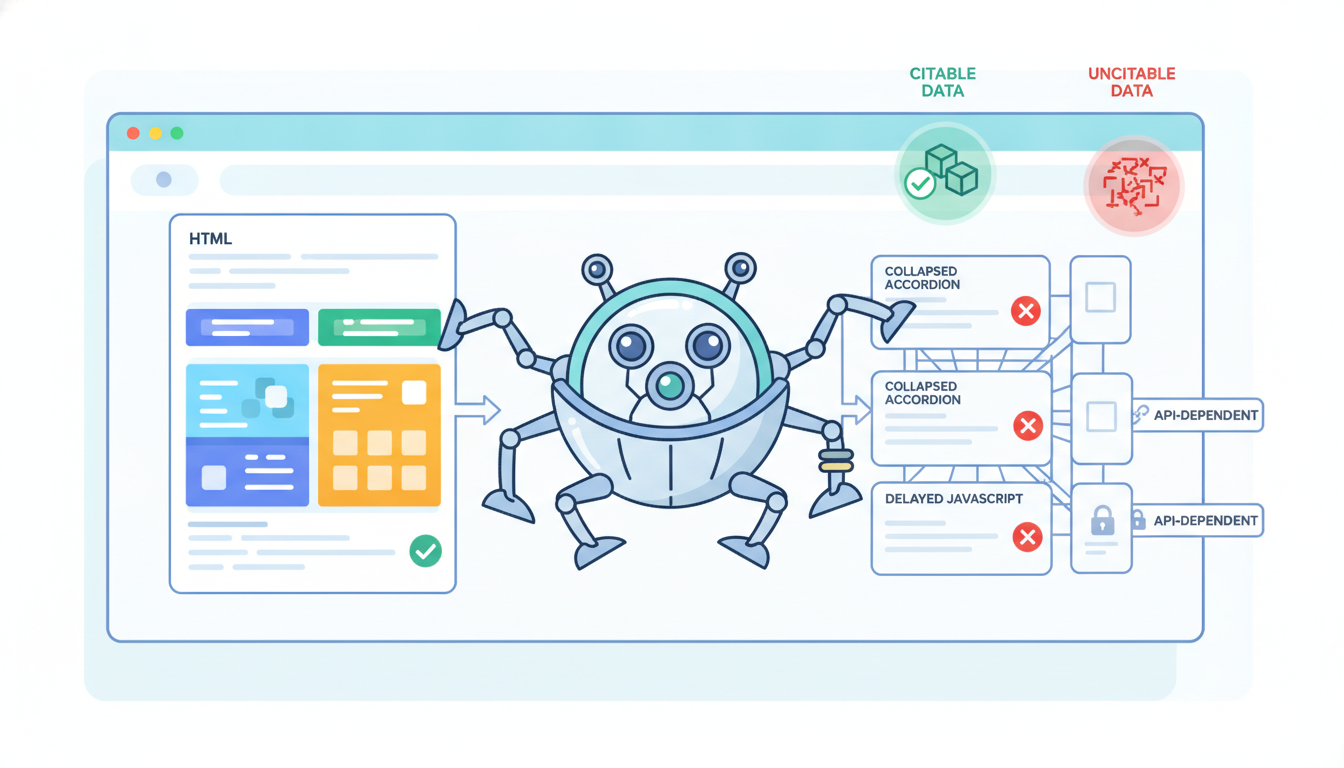
The bot must receive the full document, not a promise of it
In JavaScript-based environments the most common problem is not "does the page load", but "what does Googlebot actually see and when does it see it". Google still recommends building pages so that key content is available and does not depend on delayed client-side actions [4]. If the main article block, comparison tables, expandable sections or contextual navigation elements appear only after scripts run, after interaction or after fetching data from an external API, the risk of losing signals increases.
In the context of AI Overview this matters even more, because the system needs not only the title and the lead. It needs the full content with definitions, dependencies and fragments that can be safely quoted. If part of the document does not render stably, the model receives an impoverished version, and it is then more likely to reach for a competing source.
In practice the best-performing sites are those where the main content is embedded in the HTML already at the server response stage or at least renders deterministically and quickly. This applies not only to blog posts. The same problem appears on category pages, product landing pages and knowledge hubs. Even in medical or specialist sites, where educational content sits alongside commercial sections, the document must remain semantically unambiguous. For a user interested in monitoring heart function a clear path between educational content and related resources such as holters or ECG electrodes is important, but for the crawler it is equally important that these relations are readable in the code and information architecture.
Crawl budget isn't only a problem for giants
For years the topic of crawl budget was overused, but in sites with a large number of addresses, filters, parameters and pagination it remains real. Google explains that crawling efficiency depends on a combination of crawl limit and crawl demand [5]. If a site produces thousands of low-value URLs, duplicates content via parameters, indexes internal search pages or leaves orphaned resources, the crawler wastes resources on documents of no significance.
This directly affects the visibility of content that has a chance to be included in AI Overview. In practice this means the need to tidy indexing: consistent canonical tags, parameter control, cutting thin pages from the sitemap and removing conflicts between noindex and internal linking. Simply "allowing the crawler in" is not enough. You also have to show it which documents are central to the topic and why.
Document structure: a language model works better with content laid out like an expert document

Headings are not decoration; they're a map of meaning
A large part of the problems with visibility of expert content stems from a simple mistake: authors write logically for humans but illogically for the system. H2s and H3s are random, sections mix definition with opinion, and several different user intents land in one block of text. For AI that is a signal of chaos.
A well-designed document leads from the problem to the mechanism and then to implementation conditions. If the topic is "technical SEO for AI Overview", the model should easily recognize sections on rendering, indexing, structured data, trust, performance and information architecture. Not because it "looks nicer", but because such an arrangement facilitates extraction of partial answers.
In practice the most effective are sections with high information density, a clear heading and a development focused on a single problem. Then a single paragraph can function as a citable fragment. When a document jumps between threads, its usefulness for generative systems decreases.
Entities, definitions and relationships between concepts
Google has long been developing understanding of entities and semantic relationships, and documents that clearly identify concepts, roles and dependencies are easier to interpret [6]. In practical technical terms this means the site should clearly communicate what an entity is, what it is associated with and where its elaboration can be found.
For a text about SEO 2026 the entities are not only "Google AI Overview" or "structured data". They also include auxiliary concepts: crawlability, rendering, canonical tags, schema.org, authorship, server logs, JavaScript SEO, topical authority. If a document uses these terms consistently, develops them in appropriate sections and supports them with internal linking to related resources, the system more easily builds a map of meaning around the domain.
This is one of the differences between content "written for a keyword" and source content. The latter not only answers the query. It organizes the topic.
Structured data: they don't guarantee citation, but they limit the scope for misinterpretation
Google repeatedly points out that structured data helps systems better understand page content, though by itself it is not a guarantee of better rankings [7]. In the context of generative search it still matters a lot. A model that uses search signals acts more confidently when a page clearly communicates the document type, author, publication date, organization, breadcrumb, FAQ section or product.
The most common mistake is mechanically implementing schema without consistency with the content. An article marked as Article but without a clear author, update date and consistent title gains little. It looks even worse when implemented schema types contradict each other or describe content the user does not actually see on the page. That does not clarify interpretation. It obscures it.
In practice modest but precise implementations work well. For expert materials the basis is usually Article, WebPage, Organization, Person, BreadcrumbList, and depending on the format also Product or MedicalWebPage. However, you must ensure entity consistency between schema, content, editorial footer, author page and company information. If the article speaks with one voice, schema another and the author profile a third, the system does not get a coherent picture of the source.
E-E-A-T in the technical layer: credibility must also be visible in code and architecture
E-E-A-T is not a single ranking factor, but a set of qualitative signals that Google uses when evaluating content, especially in areas that require trust [8]. Many site owners treat this only editorially: they add an author bio and stop there. That's not enough.
The technical side of E-E-A-T begins where information about authorship, editorial oversight and responsibility for content becomes consistent and verifiable. The author page must exist as a separate entity. Organization data must be stable. Publication and update dates should be readable. Internal linking should lead to pages that confirm expertise, not leave the author's name as dead text.
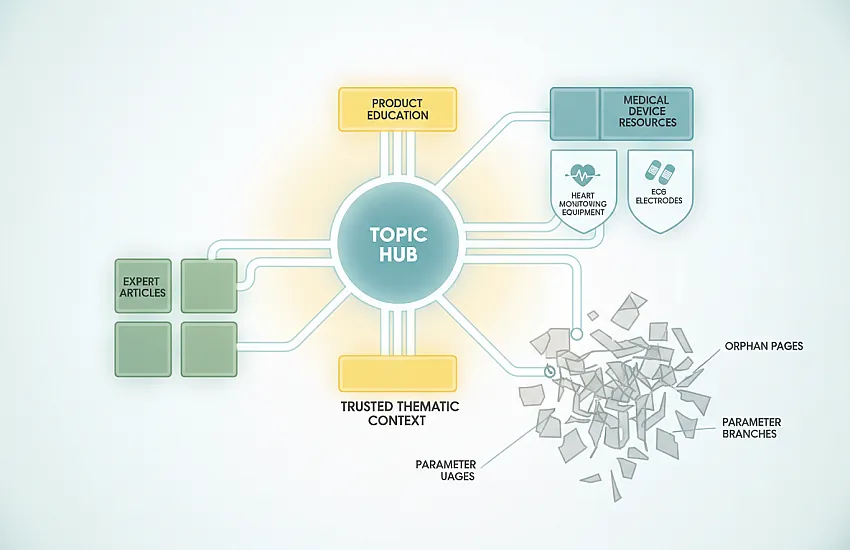
For specialized topics the separation of roles also matters. You design a medical document differently than a technical blog post, and differently than a product page. When a user reads material about health monitoring parameters, it is natural to embed it in a broader thematic context that includes, for example, oximeters and pulse monitors. For the search engine this is a signal that the domain does not publish random texts but develops a related area of knowledge. That effect does not arise from a single article. It emerges from the architecture of the whole site.
Performance and site stability: speed doesn't end at Core Web Vitals
Core Web Vitals remain a relevant benchmark for page experience quality, and Google still publishes recommendations regarding LCP, INP and CLS [9]. In practice under AI Overview it matters not only whether the page "is fast", but whether its main content becomes quickly available and stable during rendering.
If the layout shifts because of ads, sticky bars, undersized images and modules loaded late, the system may have greater difficulty unambiguously extracting the correct content block. The user feels this too. In longer expert pieces every element that impedes reading lowers the chance of deep consumption of content, and that indirectly affects quality signals.
From an implementation perspective the greatest value usually comes from three things: prioritizing above-the-fold content, limiting heavy third-party scripts and reducing elements that disturb the DOM after load. It doesn't sound flashy, but very often these simple fixes decide whether a page is a stable document or a collapsing composition of widgets.
Information architecture and internal linking: AI doesn't trust sites without topical context
A single good publication rarely builds lasting visibility in generative search. Systems prefer sources embedded in a larger topical structure. That's why information architecture returns to the center of technical SEO today. Not only as a UX issue, but as evidence that the domain understands the topic more broadly than at the level of a single answer.
In practice this means building content clusters in which pillar pages, concept elaborations, comparison materials and product resources mutually support each other. Internal linking should not be random or based on automatically injected "related posts". It must show logical relationships: a definition leads to an elaboration, elaboration to applications, applications to tools or categories, and category pages back to expert knowledge.
This is especially important in specialized and regulated industries. A site that describes only individual devices or publishes inconsistent advice has a weaker semantic profile than a domain that systematically develops related entities, parameters and use cases. Google trusts structure more easily than declarations.
Server logs and indexation monitoring: without technical data you're operating in the dark
Many visibility problems under AI search do not appear in standard ranking reports. A site can have the correct title, good content and decent CWV, yet Google may rarely refresh key addresses, lose some rendered content or skip important sections due to incorrect technical signals. You cannot see that without server logs and without regular analysis of how crawlers actually move through the site.
Log analysis allows you to check which types of URLs are being over-crawled, where Googlebot falls into parameter traps, which sections are neglected and how quickly the bot returns to freshly updated content. That's operational knowledge. Without it you can easily fall into the trap of apparent diagnoses, for example blaming content for lack of growth when the real problem lies in indexing or rendering.
On top of that comes monitoring indexation statuses, anomalies in sitemaps, conflicts between canonical/noindex and inconsistencies between source HTML and the post-rendered version. In 2026 this will not be a "technical detail for large sites". It will be the standard way of working on sites that want to be a source for AI-generated answers.
A practical problem that occurs most often: the content is good, but the document is not suitable for extraction
This is a scenario that repeats regularly. The editorial team prepares a strong piece. There are definitions, data, expert commentary. Yet the page does not gain the visibility one would expect. Once you get into the technicals it turns out the lead is hidden under a huge hero, subheadings do not reflect the content, the most important paragraphs sit in tabs loaded by script, and the author does not exist as a distinct entity on the site.
For a human such material can still be useful. For the system it is difficult to process. And generative search rewards documents from which meaning can be extracted quickly and without guessing. That is why technical SEO for AI Overview cannot be treated as a separate audit performed at the end of a project. It must influence the way templates are designed, content composed and the whole site maintained.
SEO 2026 requires thinking in terms of documents, not individual URLs
The biggest change does not lie in a single algorithm update or a new tag. It lies in the approach. We stop optimizing solely "a URL for a phrase" and start designing documents and clusters of documents that are understandable, coherent and worthy of citation. Google has been developing systems to evaluate content quality and source usefulness for years, and AI Overviews only make that logic more prominent [1][2].
From a technical perspective this means combining several layers: rendering, indexing, HTML semantics, structured data, E-E-A-T signals, performance and information architecture. When one of them fails, the problem will not always be immediately visible in rankings. It often only becomes apparent when competitors begin to appear as sources of synthetic answers, and your site remains just an ordinary result or disappears from view.
And that is why a technical checklist for Google AI Overview should not be understood as a list of minor fixes. It is rather a system of requirements that decides whether a site can be read as a credible source of knowledge.
Case study: technical SEO 2026 checklist for Google AI Overview and generative search in practice
At the end of one quarter, a service-and-retail company with an extensive expert site and an e-commerce backend approached us. The client's team had no problem producing content. They published regularly, had their own subject-matter specialists, and some of the materials were genuinely good. The problem arose elsewhere. Organic traffic to articles was growing more slowly than before, some new publications waited a long time for meaningful indexing, and in tutorial-comparison queries they began losing to sites that at first glance had weaker content.
The client didn't come with the question: "how to raise rankings by two positions". They came with a more specific observation. In reports they saw that their content was sometimes visited by bots, but did not function as a source. It didn't appear where a user expects a synthetic answer, and some materials looked as if Google only partially understood the topic. It was a good moment to work not on the articles themselves, but on whether the site could be technically "read" as a reliable answer base.
Brief context of the situation
The site was complex. It had a tutorial section, a product section and sections supporting sales. In some areas the topics were specialized, close to health and home diagnostics, so alongside educational content there were also product categories such as holters, ECG electrodes or oximeters and pulse meters. From a business perspective that made sense. The user would read a guide and then could move to a specific solution. From the point of view of SEO and AI search the layout was, however, less obvious than the client assumed.
Content was created by specialists, but implementations were handled by a separate development team, and templates were the responsibility of a UX agency. That's a fairly typical setup. Each page worked correctly "on its own", but nobody looked holistically at what the bot actually sees, how it understands the document structure, and whether individual elements weren't sending conflicting signals.
Client's problem
The most important symptoms were four.
New articles needed more time to gain stable visibility.
Comparative materials and checklists had a high share of long-tail entries, but performed poorly on synthetic queries.
Google more often indexed intermediate versions, paginations and parameterized addresses than some central pages for the cluster.
In the knowledge section and on expert landing pages there was a growing number of cases where the title suggested one intent, but the document was a mash-up of several different topics.
The client initially assumed the problem lay in the content itself. That was the first false lead. After a quick verification it was clear that some texts were substantively strong enough, but documents and templates did not support them in a way that would increase the chance of being used by generative systems.
Situation analysis
We didn't start with a classic "a bit of everything" audit. We set a simple order: first we check which types of subpages matter most for visibility in synthetic answers, then we look at what hinders content extraction, and only at the end do we tighten supporting issues like schema or order of editorial updates.
We split the analysis into five working blocks.
Comparison of source HTML with the rendered version.
Mapping templates for articles, guides, categories and expert landing pages.
Server log analysis regarding the actual crawl path.
Checking the relationship between sitemaps, canonicals, pagination and parameter indexing.
Assessment of whether the most important content sections have stable, citable answer blocks.
After the first few days things appeared that weren't visible in standard SEO dashboards.
What we found
First, some key paragraphs in the guides loaded only after the "read more" module initialized. For the user that worked fine. For the bot not always. In the render the sections were sometimes available, but with delay and without full stability. In practice this meant the document had a topic, but lacked immediately visible expansions that most often serve as material for quoting.
Second, the article template was overloaded with conversion-supporting components. CTA boxes, sticky elements, recommended content, comparison widgets and product modules appeared early in the DOM structure. The main content itself wasn't hidden, but lost priority. This isn't an error that instantly kills SEO. However, for expert documents it starts to interfere when the system needs to extract the main answer without guessing what the page's axis is.
Third, the client had seemingly correct internal linking, but its logic was too sales-oriented. From an article about monitoring health parameters there were direct links to categories like blood pressure measurement or oximeters and pulse meters, but there was a lack of an intermediate layer: pages explaining uses, limitations and selection criteria. For the user some of these transitions were too fast. For the search engine the site sometimes looked as if it was trying to shortcut the path from knowledge to offer without building the full context of entities.
Fourth, we found an editorial-technical conflict. The content team updated older publications, but the CMS only overwrote the update date visually. In structured data and in some templates the date remained old. It's a small detail, but such small details break signal consistency.
Fifth, logs showed the bot spent a surprisingly long time on filtered and technical variants of listings. The site wasn't huge, but it was large enough for this mess to start costing real Googlebot attention [5].
How we approached the solution
We didn't make a revolution. That's important, because in such projects it's easy to overdo it and rewrite half the site for a theoretical "ideal model". Usually that ends with delays, team conflicts and the loss of what already worked. Instead we built an implementation checklist for three goals:
make it easier to extract answers from documents,
order indexing priorities,
increase semantic consistency between content, code and site architecture.
Step 1: rebuild the expert template without changing the entire front end
Instead of designing a new layout, we worked on the existing template. We decided that the first screen of the document should contain four things in a fixed order: a clear headline, a short answer about the topic, authorship and navigation between sections. Promotional boxes and additional modules were moved lower.
The biggest change wasn't visual. It was about ensuring the main answer and structure of sections are present in the DOM immediately, without waiting for user actions. In practice several materials gained not only better indexing stability after this change, but also a larger share of entries on question-form long-tail queries.
Step 2: separating documents that mix intents
This was a tougher stage because it hit earlier content assumptions. The client liked extensive "all-in-one" articles. The problem was that some of these materials contained a definition, a buying guide, a device comparison and a technical FAQ on a single subpage. For the reader that can sometimes be convenient, but for generative systems that format is less predictable.
We didn't split everything automatically. We selected a dozen or so URLs with the greatest potential and broke them into logical sets: a main topic page, a separate comparison, a separate use-cases page, a separate parameter expansion and a separate transactional material. Only then did internal linking start working for topical authority instead of scattering the context.
Step 3: ordering indexing and sitemaps
We implemented separate sitemaps for expert content, categories and product pages, and removed from the maps some addresses that were formally available but shouldn't be treated as central topical documents. Along the way we fixed a few inconspicuous errors: canonicals pointing to URLs not matching the final version, internal links leading to parameterized addresses and archival pages that were absorbing crawl without real value.
This wasn't the flashiest part of the project, but it produced quick operational effect. Logs already after a few weeks showed a more sensible distribution of bot entries to the sections that really mattered.
Step 4: tightening authorship and editorial responsibility sections
The client had authors, but no consistent author system. Some names led to empty profiles, some to pages without specialization, and some were just text under the headline. We built a simple model: every author got their own page, visible specialization, update history and links to publications. For more sensitive materials we also added a peer review.
That's not a conceptual novelty. The difference was execution. We made sure author information was consistent in content, schema and navigation elements. Google has long indicated that content quality assessment systems rely on many signals of usefulness and credibility [1][2][8]. In practical projects sites lose the most when they have these signals but scattered across five places.
Step 5: correcting schema where it actually helped
We didn't add structured data "just in case". We removed some implementations that were formally correct but didn't organize anything. We left those that made sense for the page type and matched what the user actually sees: Article, Person, Organization, BreadcrumbList and selected extensions for FAQ sections [7].
Interestingly, the weakest point wasn't the lack of schema, but inconsistency between schema and the document. When we aligned that, some incorrect interpretations in results disappeared and snippet predictability improved.
Difficulties along the way
This project didn't go smoothly. The biggest resistance appeared when changing templates, because the sales team feared that moving offer modules lower would reduce transitions to products. That's understandable. In practice we had to show that an expert document cannot look like a landing page with an article tacked on.
The second problem concerned historical content. The client had a large publications library and it wasn't possible to rebuild everything at once. We therefore established a prioritization model: first pages with quoting potential and high alignment with informational intent, then pages supporting clusters, and finally the rest of the assets.
The third difficulty was purely technical. Some front-end components were shared between the blog, guides and categories. A small change in one place broke something elsewhere. This required several iterations and render tests. In two cases we had to roll back a deployment because the new layout improved document readability but worsened CLS on mobile. Only after another fix were we able to preserve page stability and content logic [9].
Practical actions that gave the biggest effect
From the whole project the most effective elements were not the most "advanced", but the most orderly.
Moving the key answer and summary higher in the document.
Removing expandable sections from the most important parts of guides.
Separating materials that combined several intents into separate documents.
Strengthening the authorship and editorial responsibility layer.
Cleaning sitemaps and limiting wasted crawl on intermediate addresses.
Rebuilding linking so that definitions lead to use-cases, and only then to the offer.
In practice the model of transitions between educational content and product categories worked particularly well. Instead of directing the user from the first paragraph straight to a purchase, we introduced bridging pages. As a result a piece about heart monitoring could naturally lead to an explanation of differences in use-cases, and only from there to sections like holters or ECG electrodes. This improved both cluster logic and the quality of the user journey itself.
Results
There wasn't a single day when everything "clicked". The effect came in stages.
After about six weeks we saw a clearer order in crawling of the most important sections and faster refreshing of some updated publications. In subsequent weeks visibility for question and comparison queries improved, especially where documents had previously been too heavy, too mixed, or too aggressively surrounded by peripheral components.
The most valuable change, however, wasn't about rankings themselves. The client began to see which types of content have real potential to be a source, and which just generate dispersed traffic. That allowed them to plan editorial work, implementations and the architecture of future materials differently.
In numbers the project looked reasonable, without fireworks. Among the group of priority URLs the share of indexed and regularly refreshed pages increased after three months, the time for new publications to reach stable visibility shortened, and organic long-tail traffic to reworked materials rose moderately but consistently. More important was that fewer high-quality pieces "disappeared".
Practical conclusions
Several takeaways recur regularly when working for AI Overview and generative search.
First, the technical checklist should not be a list of detached items to tick off. It must stem from the role a specific document type plays. You evaluate a pillar page differently than a comparative guide or a category that supports a purchase decision.
Second, the biggest losses often don't arise from glaring errors. A site can be correct, fast and indexable and still lose as a source because it mixes intents, dilutes the answer or buries the main content under peripheral modules.
Third, without logs and comparing render with HTML it's easy to reach wrong conclusions. On the dashboard everything may look decent, while the bot actually works on a poorer or less ordered version of the document [4][5].
Fourth, on sites that combine education with offers you must be very careful about transitions between knowledge and sales. Natural, contextual links to resources like blood pressure measurement or oximeters and pulse meters can strengthen the topic. However, if they are inserted without appropriate semantic context, they start to weaken the readability of the whole cluster.
Fifth, SEO 2026 for generative search is largely work on document predictability. It's not only about making the page accessible. It's about ensuring the system doesn't have to guess what the answer is, who is responsible for it, how it's embedded in the topic and which URLs on the site are truly central.
That was the most important effect of this collaboration. The client stopped looking at technical SEO as a set of post-deployment fixes. They began to treat it as a condition for building content that has a chance to work not only in classic results but also in synthetic answer environments created from multiple sources [2][3].
FAQ: SEO 2026 – technical checklist for Google AI Overview and generative search
Does a separate version of content "for AI Overview" make sense, or is it a simple path to cannibalization?
In most cases, a separate version of the same material is a bad idea. The problem is not the mere existence of two URLs, but the splitting of signals. One document starts collecting links, another updates, a third long-tail entries, and Google receives several similar answers instead of one strong source page. With generative search this is particularly risky, because systems choose content that is coherent, stable and easy to attribute to a single central document.
The layered model works much better. Instead of creating a "version for AI", you build one primary document and surround it with supporting materials that have distinct intent. The pillar page answers synthetically and broadly. Separate URLs expand on exceptions, implementation scenarios, comparisons, errors and edge cases. Then you are not competing with yourself, but strengthening the main topical entity.
There is also an editorial dimension. Teams often try to "rewrite" an article to make it shorter and more quotable, but in practice this leads to shallower content. A better solution is to restructure the same page: add a short answer at the top, standardize sections, add blocks that respond to specific user questions, and only then deepen the topic. This way the document is useful for the reader, strong for SEO and more susceptible to extraction by generative systems.
Exceptions exist. If you have one piece that simultaneously tries to be a definition, an implementation guide, an audit checklist and a service landing page, separation may be necessary. Not because "AI likes short texts", but because each of those intents requires a different document structure. It's an architectural decision, not a cosmetic one.
How to approach pages with a paywall, content blocking or gated content if I care about visibility in AI search?
If the most important substantive value is gated too early, expect that the system will not see the full context. It's not only about classic indexing. In synthetic answers a source must be understandable without guessing, and an aggressively hidden document usually loses to open content that provides the definition, the mechanism and the key conclusions without an access barrier.
That doesn't mean you have to give everything away for free. The "open core" model works well. The user and the search engine get the full skeleton of the answer: what the problem is, what the variants are, when a given solution makes sense, what to avoid, and what the limitations are. Behind the form you can leave premium elements: ready templates, benchmarks, decision sheets, implementation templates, operational checklists, downloadable files or calculators. Then the public URL can still be citable, and the lead magnet remains genuinely valuable.
You also need to watch out for technical implementations of a paywall. An overlay covering text after a few seconds is one thing, but fully removing content from the HTML or loading it only after user validation is a completely different level of risk. From the search engine's perspective what matters is what can be read in a predictable way. If the subscription architecture was implemented without consultation with SEO and development, it's very easy to destroy the potential of a document that was editorially excellent.
In specialist industries one more rule applies: don't hide the explanatory layer, hide the working layer. When you publish material about health monitoring, the basic educational context should remain open, and only the more advanced resources can be tied to an offer or download. This arrangement also better leads the user to commercial resources, for example sections for Holter monitors or EKG electrodes, without breaking the readability of the main document.
Can automatic translations and multilingual versions reduce the chances of being cited by AI?
They can, but not because automation was used per se. The problem starts when a language version is formally translated but semantically empty or unlocalized. Search models very effectively spot content that sounds grammatically correct but does not respond to the real way questions are asked in a given language. In practice this means that a "word-for-word" translation can have correct HTML, schema and linking, yet still perform poorly as a source.
I see the most problems in three areas. First is incorrect intent mapping. An informational query in Poland does not have to have the same structure as its English counterpart. Second is inconsistent entities. Names of services, products, standards or features are sometimes translated differently each time, so the domain doesn't build a coherent knowledge graph. Third are implementation errors: hreflang pointing to wrong equivalents, lack of reciprocal links, mixing languages within one template, and sometimes even copying the same structured data without updating local fields.
For AI search it's particularly important whether each language version looks like an independent, credible document and not an export from a spreadsheet. That also includes authorship, examples, units of measure, industry terminology and local purchasing contexts. If you publish content where a user can move from a guide to a product category, that transition must also feel locally natural. In the Polish version that might be e.g. oximeters and pulse monitors or blood pressure measurement, not a calque from a foreign naming architecture.
Automation can speed up production, but without an editorial and technical layer it's easy to create a large number of pages that formally exist but do not build authority. And in generative search weak, repetitive language versions are usually not cited.
How to measure the impact of AI Overview, since Google Search Console does not have a complete, convenient "citations by AI" report?
You have to move away from the idea that one dashboard will show the whole picture. It won't. In practice, sensible measurement consists of several layers that together yield useful conclusions.
The first layer is changes in query types. If after a technical rebuild the share of question, comparison, definitional and problem queries rises, and at the same time CTR on some of them falls or fluctuates wildly, it can be a signal that your content is being "served" earlier in the SERP by synthetic elements. A CTR drop alone proves nothing, but combined with increased exposure to high-level queries it gives a direction for interpretation.
The second layer is manual and semi-automated monitoring. For priority clusters it's worth building a list of queries and regularly checking which sources appear in AI Overview, what types of documents are being chosen, whether pillar pages, comparisons, definitions or forums are cited. This allows you to spot patterns that traffic analytics alone won't show.
The third layer is log analysis and refresh frequency. If after technical changes you see faster robot returns to certain types of documents, shorter time between publication and the first meaningful crawl, and more regular visits to central pages for the cluster, it's usually a sign that the site has become operationally easier for Google. This is not yet proof of citation, but it often precedes better utilization of content.
The fourth layer is post-entry behavior analysis. Documents that actually answer high-intent questions often generate fewer random sessions but more transitions to next steps. For a site that combines content and offers, it's important not only how many people read the article, but whether they moved on to bridging pages and then to product categories. If the path from knowledge to offer becomes more logical, business value increases even with less spectacular traffic changes.
Most mistakes come from companies trying to judge AI search solely by clicks. That's not enough. You need to look at visibility, query type, quality of exposure, crawl rhythm and the role of the document in the whole cluster. Only then can you assess whether technical SEO actually improved the chance of being a source.
Do forums, UGC comments and user question sections help, or do they rather blur quality signals?
Both are possible. UGC does not automatically work to your advantage. Raw comments without moderation, full of duplicates, empty opinions and random links, very often reduce the readability of the document. From the point of view of a generative system such a block can be noise rather than semantic support. Especially when it appears high in the page structure or mixes with the main content without clear separation.
However, a well-designed user questions section can be a great source of the market's real language. Not because "comments increase content", but because they show variants of the problem that the editorial team wouldn't have added on its own. In expert industries nuances often surface there: differences in use cases, device limitations, customers' false assumptions, pre-purchase doubts, post-implementation situations. This is valuable material for expanding the main document or creating separate supporting pages.
There is one condition: editorial order. The model that works best is where user questions are selected, thematically organized and processed by a specialist, rather than hanging as an uncontrolled stream of posts. Then you gain two things at once: authentic user language and a consistent expert answer.
From a technical perspective it's worth ensuring that UGC does not blow up the template. Complex comment widgets can bloat the page, load external scripts, disrupt mobile indexing or create thin user profile subpages without value. It's a detail that later ends in crawl efficiency problems and signal divergence. If you implement a question section, do it as a managed element, not as a container for everything.
How to prepare a CMS migration or redesign so as not to lose visibility under generative search?
The biggest mistake in migrations is that the team focuses on redirects and titles, while ignoring document logic. Yet after a CMS or frontend change it's often precisely what matters operationally for AI search that breaks: block order in the DOM, render stability, visibility of authorship, the way dates are marked, anchor functionality, heading semantics, relationships between desktop and mobile versions.
Therefore the migration plan should include not only a URL map but also a map of document types. You test an expert article differently than a category page, a knowledge hub, or a comparison page. For each type it's worth preparing a list of critical elements: whether the main answer is high, whether contextual linking survived, whether E-E-A-T supporting sections remained, whether a new component didn't insert a CTA before the main content, whether breadcrumbs still reflect cluster logic.
A very practical step is to run comparative tests before publishing: old HTML versus new HTML, old render versus new render, snapshots of main text, analysis of the presence of the same entities and sections. In many projects this is where it becomes clear that the redesign "beautified" the page but deprived it of machine readability. At the production stage it's already late for easy fixes.
After deployment it's not enough to watch rankings. You need quick checks of logs, indexing statuses, refresh times of key URLs, sitemap compliance, canonical behavior and changes in exposure to question and comparison queries. A well-prepared migration doesn't end on publication day. It ends only when you see that the new architecture has truly inherited the search engine's trust.
Do expert contents without a strong brand still have a chance to get into AI Overview, or do large domains mostly matter today?
Big brands have an advantage, but that doesn't mean smaller sites are doomed to the background. In practice, winners are often not the largest domains but those that better organize a specific fragment of the topic. Generative systems don't look only for the loudest name. They look for sources from which a sensible fragment of an answer can be safely extracted.
For smaller entities the key is selecting the playing field. Trying to compete broadly with giants usually ends in resource dilution. It's better to go deeper into a clear cluster, build a strong pillar page, develop supporting concepts, craft edge questions and ensure technical predictability of documents. In such areas specialization works in your favor. Especially if the content stems from practice rather than just compiling others' publications.
This is where credibility signals beyond the brand come in. It's not about excessive self-promotion but about verifiable signals: a sensible editorial policy, real authors, updates, structured service and product pages, consistent entities, logical linking, absence of technical chaos. A smaller site that is precise and consistent is often a better source for a narrow question than a large portal writing broadly but superficially.
In models combining education with offers there is another advantage: proximity to real user problems. If a domain publishes content arising from contact with customers and can naturally lead from explanation to application, its documents are more useful. Provided it doesn't shorten that path too aggressively. A user reading about monitoring health parameters can naturally reach categories like blood pressure measurement or oximeters and pulse monitors, but first they must get a proper decision-making context. Smaller brands often do this better because they know customer questions firsthand.
How often should you update the technical SEO checklist for AI search so you don't work on outdated assumptions?
There is no point in rewriting the checklist every month just because a new LinkedIn post appeared. A layered model is needed. Some points remain stable for a long time: rendering main content, order of indexing, document consistency, quality of internal linking, consistency of structured data with content, stability of templates. These are the foundations and they don't change overnight.
The second layer includes elements worth reviewing quarterly: visibility of document types, cluster effectiveness, changes in result presentation, quality of snippets, behavior of new sections after product launches, JavaScript load, emergence of new indexing traps. In this rhythm it's easiest to catch problems before they spread across the whole site.
The third layer is reactive updates. If Google changes its way of presenting answers, if you roll out a new CMS, expand your offering, launch a new market or create a large knowledge section, the checklist must be adapted immediately. Not after a quarter. In practice the best teams treat the checklist not as a PDF for the archive but as an operational document tied to the publication and deployment process.
A well-made checklist has one more feature: it distinguishes the criticality of issues. Not every technical error requires an alarm. You prioritize a canonical conflict on a pillar page differently than a minor inconsistency on a tag archive. Without that hierarchy a company quickly drowns in tasks that look good in a report but change little for the business. Team experience matters here, because most time is usually lost not due to lack of knowledge but due to wrong task ordering.
Most common mistakes in technical SEO for Google AI Overview and generative search
In SEO projects aimed at AI Overview, most losses do not stem from a lack of knowledge about individual checklist items. The problem usually lies in implementation decisions: something gets simplified, postponed, automated without oversight, or treated like classic SEO from a few years ago. Below I have collected the mistakes I most often see during audits, migrations, redesigns, and expansions of expert sites.
1. Treating AI Overview as an additional channel rather than as a quality test of the whole document
The simplest mistake: the team creates a separate set of actions "for AI", detached from the normal SEO, content, and development process. In practice this looks like someone adding a summary, an FAQ, a few structured data items and considering the topic closed. The page itself still has a chaotic layout, slow rendering, poor linking and side sections pushed before the main content.
This mistake is common because companies like to carve out new trends into separate projects. It's easier to sell internally an "AI optimization" than a rebuild of the publication process, templates, and technical control. But AI Overview does not evaluate a single add-on. It uses a whole set of signals: content accessibility, structure, credibility, context and usefulness of the document for complex queries [3].
The consequence is predictable: the page looks optimized only in the report. In results it still loses to documents that don't have flashy additions but are more coherent and easier to understand.
How to avoid this? Don't create an "AI" checklist as an overlay. Integrate it into the checks for every document type: article, hub, category, comparative guide, landing page and author page. From experience: the best results come from a simple document scoring before publication. Then we don't ask "is there an FAQ?", but: can a robot see the full answer, is the intent singular, is authorship consistent, does linking guide the user logically onward.
2. Optimizing only the pillar page and ignoring supporting documents
Many clients invest all their energy into one "most important" guide. They perfect the title, lead, schema, authorship, images and structure. The problem starts when the rest of the cluster is weak: short supporting posts, outdated comparisons, thin use-case pages, random internal links and a lack of documents answering edge questions.
This is common because the pillar page is easy to point to in a plan. It has the greatest traffic potential, so it gets attention. Meanwhile generative systems often need not only one broad answer, but also confirmation of the topic across many related documents. If a domain has one strong text and ten weak supports, topical authority looks shallow.
Result? The pillar gains some visibility but does not dominate the cluster. Detailed queries are captured by competitors, forums, documentation or comparison sites. Analyses then show a strange situation: the main page gets visits but does not build enough exposure on long-tail variants and side questions.
The solution is less flashy but effective: audit the cluster, not just the URL. For each pillar topic check whether there are separate documents for exceptions, limitations, comparisons, implementation errors, purchase scenarios and technical questions. In client work I often start with a map of missing intents, because it reveals gaps faster than a classic keyword list.
3. Implementing structured data without checking its consistency with visible content
Structured data is sometimes treated like a magical booster. A developer is given the task: "add Article, FAQ, Person, Organization and BreadcrumbList". After implementation the testing tool shows no errors, so the topic disappears from the list. However technical validation does not mean the structured data makes sense.
Most common problems: the author in the schema differs from the author visible on the page, the update date does not match the content, the FAQ in structured data contains questions not visible to the user, the breadcrumb describes a different hierarchy than the menu, and the organization has inconsistent names across templates. Google indicates that structured data helps better understand page content, but alone does not guarantee better rankings [7].
Consequences are practical. The page sends conflicting signals. Result snippets can become less predictable, and the system has greater difficulty assigning responsibility for the document. In expert areas this is particularly costly, because credibility cannot look like it was haphazardly assembled from multiple sources.
How to avoid this? Every schema implementation must be checked not only with a validator but also manually: schema versus HTML, schema versus visible content, schema versus author page, schema versus breadcrumbs. From experience: best practice is to maintain an entity map for the site. This ensures author, organization, document type and service names are not invented anew for each template.
4. Overreliance on JavaScript components that "do render anyway"
This is one of the most deceptive mistakes, because at first glance everything works. The user sees text, tables, tabs, filters and expandable sections. Testing tools sometimes see the content too. Only a comparison of the source HTML, the render and logs shows that the most important parts of the document are not available stably enough.
The error is common because modern front ends favor componentization. The UX team wants a clean view, so they hide long sections in accordions. The product manager wants dynamic modules. Developers fetch some data from the API. Each decision makes sense on its own. Together they create a document that is less predictable for a bot. Google still recommends that key content be available and not depend on delayed client-side actions [4].
The consequence need not be complete non-indexation. More often you see something worse: Google indexes the page but understands it shallowly. Visibility stalls on simple phrases, while more complex queries go to competitors with simpler, more stable HTML.
You avoid this with comparative tests. Check what is in the immediate HTML, what appears after render, what disappears when a script fails and how the mobile version looks. In projects we rarely remove all JavaScript. We just set a rule: main content, answers, headings, contextual links and authorship data must not depend on flaky components.
5. Excessive automation of internal linking
Automatic modules like "related articles", "most read" and "see also" are convenient but often break cluster logic. The problem is that the CMS algorithm selects links by tags, popularity or publication date, not by real semantic relation. As a result a definitional article links to a sales post, a comparison points to a general news piece, and a use-case page refers to content from years ago.
Why does this repeat? Because manual linking is time-consuming and content teams rarely have a full map of the information architecture. Automation seems like a reasonable compromise. Except that with AI search linking is not only a way to pass authority. It's a signal of relationships between documents.
Consequences are concrete: dilution of central URLs, poorer recognition of topic hierarchy, worse user paths and internal competition between materials. In larger sites automations can also generate hundreds of links to pages that should not be prioritized.
How to avoid this? Automatic modules can remain, but they should not replace editorial links. For each cluster prepare a manual map: central document, expansions, comparisons, problems, use cases, transactional pages. From practice: a link embedded in a paragraph explaining the relationship between concepts usually has more value than five random links in a box below the text.
6. Publishing updates without version control, dates and editorial responsibility
In many sites content updates are treated too superficially. An editor adds two paragraphs, changes the date in the page view and publishes. No one checks whether the date changed in the schema, sitemap, feed, author profile, cache system and version history. As a result the document tells several different things at once.
This mistake is common because updates are distributed across content, SEO and development. Each is responsible for a different part of the process. There is no single procedure "what must change when content has been materially updated".
Consequences can be quiet but costly. Google may see the page as old despite a fresh date visible to the user. The user may not know whether the material was actually verified. With expert content E-E-A-T suffers, because Google evaluates credibility and usefulness through many qualitative signals, especially in topics that require trust [8].
How to avoid this? Separate three concepts: publication date, technical modification date and substantive update date. Not every minor correction justifies showing a new date. But if meaning, recommendations, data or the scope of answers change, the update must be consistent everywhere. In practice a short editorial changelog available internally works well. It lets you quickly check who, when and why changed a document.
7. Ignoring low-quality pages because "they are not part of the AI strategy"
Companies often focus on their best articles and forget the rest of the index: tags, archives, filter parameters, internal search results, old campaign landings, category duplicates and test versions. The argument is: "these are not pages we want to show in AI Overview". The problem is that the bot may still pay attention to them.
This mistake is common on sites developed over years. Every campaign, filter, integration and CMS change leaves behind addresses. Nobody feels responsible for cleaning up. Meanwhile crawl efficiency depends, among other things, on crawl budget and crawl demand, and an excess of low-value URLs can draw attention away from central documents [5].
Effects are visible in logs: the bot visits pages with parameters, old paginations, duplicates and technical addresses more often than new expert content. Publications wait long for a stable refresh, and updates do not propagate quickly into results.
Solution: regular index and sitemap review. This is not about mass noindex without analysis. Decide which types of URLs should exist in the index, which should be only crawlable, which to block, and which to remove or redirect. From experience: cleaning up "junk" URLs often produces a bigger effect than another cosmetic fix on the pillar page.
8. Designing for citation at the expense of human usability
After the arrival of AI Overview some teams began writing documents as collections of short answers. Each section must be "quotable", so the text becomes fragmented, repetitive and devoid of natural flow. This is the other extreme. The document is fit for extraction of snippets but weak as a complete answer for the user.
The mistake comes from misunderstanding generative search. Models do not need only short blocks. They need content that has clear fragments but also context, conditions, exceptions and justification. If a page looks like a set of shallow answers, it easily loses to material that better explains the problem.
Consequences are twofold. The user leaves the page sooner because they do not get real decision-making support. Search systems see a document that answers superficially and does not build topical authority. For harder queries this is not enough.
How to avoid this? Design sections so the first sentences give a clear answer and the remainder explains the mechanism, limitations and practical application. In editorial work a useful test is: can a paragraph be quoted independently, but does the whole chapter still have value when read from start to finish. If the answer to both is "yes", the document is usually well-constructed.
9. Pushing technical tests to the end of the project
The most expensive organizational mistake: SEO gets the page to check only after deployment. Then it turns out that components are already coded, templates approved, migration planned, and fixes require undoing work by several teams. The technical checklist becomes a list of compromises.
Why is this common? Because SEO is still often treated as a post-publication check, not as an element of document design. Especially in redesigns and migrations decisions about DOM structure, block order, menu, linking, author data and page types are made earlier than the SEO audit.
Consequences are costly: loss of some signals, indexing problems, worse layout stability, canonical conflicts, disappearing contextual links and components that worsen Core Web Vitals. Google still relates page experience quality to metrics like LCP, INP and CLS [9].
The simplest method to avoid the problem is to introduce control gates: before the mockup, before development, before staging and before publication. On staging you must check not only the browser view but also HTML, render, links, schema, sitemap, canonicals and the mobile version. From experience: one hour of consultation before designing a template can save several weeks of fixes after deployment.
10. Evaluating results solely by organic traffic
The last mistake concerns measurement. A company implements technical fixes, after a month checks organic traffic and concludes that "AI SEO doesn't work" because sessions didn't jump. That's too narrow a perspective. With AI Overview some value may appear as greater exposure, better coverage of question-type queries, faster content refresh, more stable positions or a higher share of visits from intent closer to decisions.
The mistake is understandable because traffic is easiest to report. The problem is that synthetic answers can change CTR, and mere presence as a source does not always immediately translate into a proportional increase in clicks.
The consequence is poor prioritization. The team abandons actions that improve the site's ability to be a source and returns to producing more articles without organizing the foundations. After a few months they have more content but not necessarily a greater advantage.
How to measure more sensibly? Observe groups of URLs, not single posts. Check changes in query types, indexing, logs, crawl frequency, snippet quality, visibility in comparison questions and transitions to subsequent pages in the cluster. In practice dashboards that combine SEO data with a map of document types work best. Then you can see whether you are improving the real usefulness of the source or just generating traffic without further value.
Myths and misconceptions about technical SEO 2026 for Google AI Overview and generative search
There are many simplifications around AI Overview and generative search. Some come from old SEO habits, some from observations taken out of context, and some from the industry’s typical search for one “secret” factor. In practice, these simplifications are what most often break implementations. Below I collected the myths that regularly come up in conversations with SEO, content, and development teams.
Myth 1: “Just implementing schema is enough to increase the chance of appearing in AI Overview”
This belief came from a very simple association: if the search engine uses structured signals, adding more markup should automatically improve the page’s “understanding.” The problem is that schema has never worked that way. Google clearly states that structured data helps better interpret content, but by itself does not guarantee better visibility or special treatment of a document [7].
Where do companies fall into the trap? Usually where schema implementation replaces order within the document itself. The article is marked as Article, the author is Person, the company is Organization, but the main answer is diluted, sections mix several intents, and the visible content does not match what the code declares. Then schema doesn’t fix the problem. It only reveals the inconsistency more precisely.
The market reality is much less spectacular. What works well is not “a lot of schema,” but schema that aligns with the content, the role of the URL, and the logic of the whole site. From experience: I more often improve overblown implementations than overly modest ones. Sites tack FAQ where there are no real questions, expand entity types unnecessarily, or describe in the data things the user cannot see. It looks ambitious in an audit, but operationally usually doesn’t strengthen anything.
The practical conclusion is simple: if you have to choose, it’s better to have sparse, consistent structured data than an extensive implementation based on a wishful description of the page.
Myth 2: “Google AI Overview prefers only big brands, so technical SEO for smaller sites makes limited sense”
The source of this myth is understandable. In many industries broad queries are dominated by strong domains, publishers, and recognizable brands. It’s easy to conclude that a smaller site has no chance regardless of implementation quality. But that conclusion goes too far.
Google has long relied on many signals of usefulness, quality, and trust to evaluate content, and AI Overviews use sources to build synthetic answers, especially for more complex queries [1][2][3]. This doesn’t mean only the largest win. It rather means the system prefers documents that are unambiguous, credible, and well-embedded topically.
In practice smaller sites often lose not because they are small, but because they try to pretend to be large portals. They bloat structure, create dozens of thin subpages, copy a newsroom publishing style, and scatter topical authority. Meanwhile for the search engine and content-synthesizing models a narrower domain that is more semantically consistent can be much more valuable.
From experience: a small expert site can work very well on the long tail, specialist questions, and comparative queries if it has order in entities, editorial responsibility, and document hierarchy. The question is not “are you a big brand,” but “can you be trusted as a source within a specific topic slice.”
Myth 3: “For AI search you need to shorten content because models only take short fragments anyway”
This myth grew from the observation that synthetic answers often use short, concise blocks. Some teams drew the wrong conclusion: the shorter the text, the better. Reduced content began to appear consisting of just a few paragraphs, stripped of conditions, exceptions, and context.
The problem is that generative systems don’t look exclusively for short sentences. They look for material that can be summarized without distorting the meaning. That’s an important difference. Short text can be quotable, but if it doesn’t develop the topic, explain relationships, and satisfy the user’s intent, its value as a source declines.
In real projects layered documents work best: they give a clear answer up front, then expand the mechanism, limitations, edge cases, and use. Such a structure allows content to work for featured snippets, classic SEO, and generative search at the same time. Google has for years been reinforcing useful, satisfying content, not texts mechanically shortened to the minimum [1][2].
Practical observation: when companies aggressively shorten expert materials “for AI,” they usually return to expanding content after a few weeks. The reason is simple. The user gets a superficial answer, and the document stops building topical advantage over competitors.
Myth 4: “Noindexing weak pages will always improve the situation in AI SEO”
This is one of the most harmful shortcuts in thinking. It stems from a real observation: indexing clutter can weaken a site. Google points out that crawling efficiency depends on the relationship between the crawl limit and crawl demand [5]. Based on this many teams automatically conclude that it’s enough to mark weaker pages as noindex en masse.
But noindex is not a strategy by itself. If the page is still heavily internally linked, appears in navigation paths, generates duplication, or produces unnecessary URL variants, the tag alone does not solve the deeper architecture problem. Sometimes it even obscures the picture, because formally “we clean the index,” but structurally we leave the same chaos.
Reality looks different. There are addresses worth keeping in the index despite low traffic because they play an important semantic role in a cluster. There are also ones that shouldn’t exist in their current form and are better to merge, redirect, or rewrite. The decision cannot come from a simple rule “few visits = noindex.”
In practice I see the most damage after mass cleanups done without an intent map and without analyzing the URL’s role. Then some auxiliary pages disappear—pages that didn’t generate much traffic but completed the topic and strengthened central documents.
Myth 5: “AI content must be neutral and impersonal because models prefer an ‘objective’ style”
This belief often appears after reading oversimplified guides about E-E-A-T. Companies start removing practical experience, expert commentary, and sector-specific detail from texts because they fear anything that sounds too authorial will be less “encyclopedic.” The effect is usually the opposite of intended.
Google in materials about content quality emphasizes the importance of experience, expertise, authority, and trustworthiness, especially in areas requiring trust [8]. This is not an encouragement to write impersonally. It’s a call to create content that shows where the knowledge comes from and who is responsible for it.
Market-wise the most effective materials are concrete, verifiable, and rooted in practice, without drifting into opinion pieces. For search systems a document that clearly shows a specialist’s point of view is much more valuable than a text stripped of responsibility and full of generic sentences.
From experience: the most “AI-friendly” documents are not the driest texts but those best documented and best grounded in real operational experience. An impersonal style very often masks a lack of knowledge, not its abundance.
Myth 6: “Since Google can render JavaScript, the loading order of elements no longer matters”
This myth regularly appears in product and developer teams. Its source is a true but misinterpreted assumption: Google renders many modern sites and handles JavaScript [4]. From this some companies conclude that you no longer need to think about content priority, block order, or the availability of the main answer at load.
That’s a dangerous simplification. The mere fact that something “eventually renders” does not mean the document is as easy to process as a simpler, more deterministic version. In the generative search environment it’s not only the presence of content that matters, but also its predictability, stability, and structural readability.
In practice two documents may contain almost identical information, and the one that works better is the one where the answer, definitions, and supporting sections are available early, without intermediate layers of front-end logic. This is especially visible in extensive technical guides, checklists, and comparison materials.
Practical observation from implementations: the biggest problems are not caused by “big JavaScript” as such, but by dependence of key content on modules designed mainly for UX, A/B tests, or monetization. Then the document works for the interface but performs worse as a source.
Myth 7: “AI Overview will replace classic SEO, so investing in engineering for regular results makes no sense”
This is a myth of false alternatives. It arose from the narrative that generative search “changes everything,” so previous rules no longer matter. In practice no cut-off happened. AI Overviews do not operate in a vacuum; they rely on the search infrastructure, indexing, document understanding, and source quality evaluation [2][3].
Therefore attempting to separate “SEO for the 10 blue links” from “SEO for AI” usually leads to bad decisions. Companies begin neglecting classic indexing reports, logs, canonicals, order in sitemaps, or render stability because they want to roll out the “new layer” faster. But without a foundation there is nothing to reinforce.
Industry reality is much more down-to-earth: technical SEO for AI Overview is an extension of classic SEO with greater semantic and document discipline. Not a separate branch. Not a separate set of tricks. Rather a higher standard of execution.
From experience: companies that achieve the best results don’t build two competing strategies. They build one document quality system that simultaneously supports indexing, ranking, citability, and content usefulness.
Myth 8: “Every article should be optimized for AI Overview”
This is a seemingly ambitious approach but usually leads to wasted resources. It comes from the belief that every subpage can become a source of a synthetic answer if given the right template, schema, and checklist. In practice not every document serves the same function.
There are contents that naturally work as sources of definitions, explanations, comparisons, and answers to questions. There are also pages whose role is different: supporting purchase decisions, closing the BOFU stage, organizing navigation, or capturing branded traffic. Trying to force every URL into the “quotable document” model results in artificial homogenization of the site.
This is especially visible in e-commerce and service sites. Categories, sales landing pages, and expert articles start to look alike because each template is expected to fulfill the same set of assumptions. That weakens specialization of page types. A document explaining a problem should work differently than a commercial page.
The practical conclusion is firm: you optimize not “everything for AI,” but specific classes of documents for their intended role. In sites with both educational and product layers it makes much more sense to build strong source pages and sensible transitions to transactional resources than to pretend every page should be an encyclopedia.
Myth 9: “If a competitor appears in AI Overview, you must copy their format 1:1”
This reflex is as old as SEO: see the winner and replicate their template. Today it takes a new form. If a competitor has a “short answer” section, three FAQ questions, a table, and an expert box, many teams want to implement exactly the same. The problem is they observe the format, not the cause of effectiveness.
The source of a competitor’s success often lies deeper: in a better separation of intents, a stronger author profile, a more stable HTML, a sensible entity hierarchy, or simply a stronger cluster supporting the topic. The section layout is only the surface.
In real analyses it often turns out that two similarly looking texts perform completely differently because one is embedded in a well-designed network of documents and the other is a lonely URL without semantic support. Copying the format without copying the logic almost never yields comparable results.
From experience: benchmarking makes sense only when you break down the competition into layers. Not just “how the article looks,” but also how it’s indexed, how linking looks, who the author is, which documents support it, and how consistently the topical entity is developed.
Myth 10: “You can build visibility for generative search without the involvement of the technical team”
This myth is especially popular in organizations that treat SEO as a content domain. Since the topic concerns answers, citation, and text quality, the assumption arises that better writing, better research, and stronger briefs are enough. The problem is generative search directly exposes the limitations of the technical layer.
Google still bases page evaluation on crawlability, rendering, page experience quality, and technical consistency of documents [4][5][9]. If the editorial team creates very good material but development delivers a template with a chaotic DOM, delayed content, incorrect canonicals, or an unstable layout, the content’s potential will be partially wasted.
Market practice is unequivocal: the best AI search projects are created where SEO, content, UX, and development work on a single document model. It’s not about months-long processes and elaborate committees. It’s about shared rules: what must be in the HTML, what can be a secondary component, how we mark authorship, how we handle updates, and which URL types are central for topics.
The most costly implementations are usually those where engineering was invited too late. Then you don’t optimize the document anymore. Then you patch compromises.
Comparison of approaches to technical SEO for Google AI Overview and generative search
The biggest mistake on this topic is lumping all sites into one bucket. The same technical checklist will work differently for a content publisher, differently for an e-commerce site with an educational layer, and yet differently for an expert site operating at the intersection of guide and sales. Below I compare solutions that in practice most often compete with each other during implementations.
1. SSR / static HTML vs CSR / heavy JavaScript frontend
The first real technical decision is not about meta tags, but about the method of delivering content. In projects for AI Overview, documents in which the main content is placed into the HTML immediately tend to perform much more stably than pages based mainly on client-side rendering. Google can render JavaScript, but still recommends that key content be available without dependence on delayed actions and unstable loading [4].
An approach based on SSR, SSG or at least deterministic rendering works best for expert sites, knowledge hubs, extensive guides, comparison pages and categories that aim to answer informational questions rather than just display a listing. It's a good choice where fast extraction of the main answer and high document predictability matter.
CSR and a component-based frontend make sense in applications, configurators, interactive tools and some areas of e-commerce where personalization or dynamic filtering are truly core. The problem begins when that same model is applied unthinkingly to content that is supposed to serve as a source.
The practical difference is simple: with SSR it's easier to maintain a consistent DOM, headings, contextual links and main paragraphs in a form ready to be read. With heavy JS you often see delays, sections loaded later, unstable modules and a higher risk that the most important content will be less readable to a crawler than to a user.
That doesn't mean every JS frontend is harmful. What harms is a poorly set priority. If a guide document has the structure of an application, it usually loses to a simpler competitor page that is technically less flashy but semantically clearer. In audits I often see companies defending complex components because "everything displays." For AI search that's not enough. It also matters whether the content is available without friction and in the correct order.
2. One large “everything-in-one” article vs separated documents by intent
This comparison concerns the architecture of the document more than the content itself, but technically it has huge significance. Many teams still like to build very broad guides: definition, instruction, comparison, FAQ, buying recommendations and a product section on a single URL. That model can still be effective for some queries, but it becomes less predictable for synthetic answers.
A large, multi-intent document works when the topic is simple, the audience is beginner-level, and the site has few resources and must build one strong central URL. This solution can also be useful when the user actually expects a complete introduction without navigating between subpages.
Splitting content into separate documents works better in mature sites that want to build topical authority and serve different intent variants. A separate definition, a separate comparison, separate use cases, separate limitations and a separate transactional piece give the system clearer signals about what a given URL actually is and which question it answers.
The practical consequence is important: a single large text is easier to promote and link to, but harder to keep semantically pure. The split model requires more editorial work, better internal linking and greater technical discipline, but it usually covers the long tail, PAA and comparative questions better.
In industry practice the hybrid model most often works best: one pillar document plus a set of strong expansions. This is especially important on sites combining education with offers. If the material discusses monitoring health parameters, it makes sense to separate the educational part from the strictly product part, and build transitions stepwise, e.g. first to content about use cases, and only then to categories such as holters, ECG electrodes or oximeters and heart rate monitors. Such an arrangement usually orders intent better than a direct jump from definition to offer.
3. A separate blog next to e-commerce vs an integrated model content + categories + bridging pages
Two models still operate on the market. In the first, the blog lives beside the shop and primarily serves an acquisition function. In the second, the educational layer is integrated with the category architecture, use-case pages and shopping pages. Both models can work for classic SEO. For generative search the differences start to become more noticeable.
The separated model is simpler organizationally. The content team publishes articles, e-commerce handles sales, and the two worlds meet loosely. It's a good starting point for companies launching content from scratch or those with too rigid CMS constraints on the shop side.
The limitation of this approach appears when knowledge and offering do not form a shared map of meanings. The blog generates traffic but does not build a strong enough entity context around product categories. From the perspective of the user and the search engine the site can then feel split into two separate entities.
The integrated model is harder to implement but usually better supports AI search. Categories are not lonely listings, and articles don't hang in a vacuum. Bridging pages, buying guides, parameter comparisons and decision-support sections appear between them. This solution is good for expert shops, manufacturers, B2B distributors and service-trade companies that want to build credibility across the entire funnel.
The practical difference is significant. In the separated model an article more often only answers a question. In the integrated model a document becomes part of a larger structure that shows not only the answer but also relationships between concepts, applications and solutions. For purchase-expert topics this is usually a stronger setup than the classic "blog → category."
From experience: integrated sites perform better where the user moves from education to comparison and only then to purchase. A good example is the path from content on parameter monitoring, through interpretation of use cases, to categories like blood pressure measurement. A category page alone doesn't answer all questions, but as part of a well-built cluster it begins to work much more strongly.
4. Broad schema implementation “just in case” vs narrow and consistent structured data
The market is divided here. Some implement almost every possible schema type, others limit themselves to the absolute minimum. Under AI Overview a selective approach is more sensible. Google clearly communicates that structured data helps understand content, but alone does not guarantee better visibility [7].
Broad schema implementation makes sense in large sites with many content types, but only if the organization has control over the consistency of entities, authors, breadcrumbs, dates, products and relationships between templates. Without that it's easy to end up in a situation where everything is formally correct but the document sends conflicting semantic signals.
Narrow and precise implementation is usually better for most companies. Article, Person, Organization, BreadcrumbList, sometimes Product or industry extensions if they correspond to the real page content. This model limits the scope for misinterpretation and is easier to maintain during updates, migrations and cluster growth.
The practical difference is not in the number of tags but in the quality of their maintenance. Extensive schema without a control process often does more harm than good. Conversely, a modest implementation that aligns with content, authorship and site architecture typically produces a more predictable effect.
In project experience predictability is more important than an ambitious number of schema types. If a team lacks a procedure for checking conformity after each template update, it's better to implement less and keep order than to create a beautiful but unstable semantic model.
5. Automatic linking by tags vs editorial linking based on semantic relations
This comparison is often underestimated because both solutions "technically work." Automatic similar-content modules are fast, scalable and convenient. The problem is that their logic rarely aligns with how a user and a search engine understand a topic.
Automatic linking is useful as an auxiliary layer, especially in large editorial sites where manually maintaining all connections would be impossible. It works well for news, timely content and low-semantic-risk sections.
Editorial linking wins where building topical authority and clear paths between documents matters. It’s the better model for guides, pillar pages, comparisons, expert sections and decision-support materials. A link embedded in the middle of a paragraph, placed in context, usually carries more meaning than an auto-generated "see also" module.
The practical consequence is clear. Automation scales well but often leads to random associations. Editorial linking is more expensive operationally but organizes relationships between entities, strengthens central URLs and better guides the user through the stages of a topic.
In projects with a sales component a hybrid usually works best. Automations remain at the bottom of the page or in an auxiliary section, while key transitions between knowledge, use cases and offers are designed manually. That way you don't have to choose between scale and sense.
6. Strong CTAs and conversion modules high in the template vs prioritizing answer and document clarity
This is one of the tougher trade-offs because it pits SEO, UX and sales interests against each other. Many teams want to show a form, product box, sticky CTA or comparison tool as quickly as possible. That's sometimes justified on sales landing pages. It often harms expert documents.
The “high and aggressive” conversion model makes sense on service pages, campaign pages, lead pages and some BOFU pages where the user is already close to a decision. There a more aggressive display of the offer does not have to disrupt the document's intent, because the intent itself is transactional.
The model that prioritizes the answer works better for informational and comparative content. If a document has a chance to serve as a source for complex questions, the main answer, section structure and authorship should take precedence over conversion. CTAs can still work, but lower and more contextually.
The practical difference is simple: in the sales model the user sees the offer faster, but the document more often looks like a landing page with appended content. In the expert model the chance of better document understanding increases, although it sometimes requires patience from the sales team because the path to the offer becomes longer.
From practice: if content concerns choosing a solution, CTAs placed after the section explaining decision criteria work much better than CTAs inserted before the problem is developed. The user then gets a reason to proceed, not just a sales stimulus.
7. Sitemaps “full because everything should be visible” vs selective sitemaps by URL role
Not every available page should be equally promoted for crawling. In practice two approaches are encountered. One assumes the sitemap should contain almost everything. The other treats it as a list of URLs that are actually meant to serve as central topical documents.
The broad model can be convenient for small sites and simple implementations where the risk of indexation mess is low. It's also suitable where almost every URL truly has search value.
The selective model is better for larger sites, extensive blogs, e-commerce with filters and projects that aim to compete for the crawler’s attention on specific clusters. Google explains that crawl efficiency depends, among other things, on crawl budget and demand [5]. If intermediate addresses, parameters, low-value listings or technical variants get into the map, priority becomes blurred.
The practical consequence is usually underestimated. A broad sitemap looks neat on paper but can make it harder for Google to refresh the most important content quickly. A selective sitemap requires more discipline, but better supports control over which URLs should be treated as source pages.
When working with larger sites the division into separate maps for document types works best: expert content, categories, products, optionally authors. Such a setup facilitates monitoring and more quickly shows where inconsistencies appear.
8. Universal checklist for the entire domain vs checklists per document type
This is an organizational difference but has very concrete implementation consequences. Many companies use a single audit sheet for the whole site. The problem is that an expert article, a category page, a comparison, a lead landing and a product page should not be evaluated identically.
A universal checklist is good at the start, for small sites or as a basic control layer. It allows quickly catching critical errors and standardizing the process across teams.
Checklists per document type are more effective in mature projects. For an article readability of the answer, authorship and heading hierarchy matter. For a category the relations between the listing and supporting content, indexation of filters and transition semantics are more important. For a comparison page stability of tables, order of arguments and the ability to easily extract conclusions matter.
The practical difference is that a universal document simplifies management but often flattens priorities. The per-page-type model is more demanding operationally but better reflects the real needs of the site under AI search.
From experience this is where the line between an "SEO audit" and an operating system runs. When a company has separate criteria for a pillar page, a category and a supporting article, it far less often publishes content that is technically correct but not useful as a source.
9. Own expert environment vs relying on UGC content, forums and external platforms
Some brands try to build visibility around a topic mainly through presence on forums, social media, industry portals and external publications. That can reasonably support reach, but it does not replace a technically organized center of knowledge of your own.
A model based on external platforms works for brands that are just entering a topic, don't yet have an editorial backbone or operate in a very competitive market where you need to quickly build traces of expertise and citations outside your domain.
A model based on your own knowledge hub is better long-term. It allows control over document structure, authorship, structured data, linking and paths to offers. In the context of AI Overview this is a practical advantage because the brand does not depend solely on someone else's template, crawl path and editorial priorities.
The practical consequence is that external platforms greaty support reach and credibility, but do not fully build your source asset. Your own domain requires more work, but it accumulates topical and editorial signals within one ecosystem.
The most sensible model is usually a combination of both approaches: your own pillar and comparison content as the core, and external publications as a layer that reinforces authority and entity coverage.
What usually wins in practice
If you look at implementations that work best under AI Overview, usually the winner is not the most advanced technology nor the most impressive design. The winner is the site that is easy to process: it has stable HTML, a clear division of intent, sensible linking, sparse but consistent schema, well-set indexing priorities and logical transitions between knowledge and offer.
That is an important difference. In classic SEO it was possible for a long time to compensate for technical imperfections with domain strength or a large volume of content. In the generative search environment sources that are less noisy but better organized more often win. And that is precisely why technical decisions that used to be "just good housekeeping" now realistically affect whether a document has a chance to serve as a source of answers, and not just another indexed subpage.
Things few people say about technical SEO for Google AI Overview and generative search
Most misunderstandings start when a technical checklist is treated as a closed document. In practice for AI Overview, the winner is often not the site that “checked the most boxes” but the one with the fewest internal contradictions. It's a subtle difference, but it only becomes apparent after implementation. Below I collected phenomena that agencies and freelancers rarely state outright, because they're hard to sell as a simple package of actions and even harder to fit into a neat table.
1. After implementing the checklist the real problem often begins: conflicts between teams
At the audit stage everything looks logical. SEO wants to simplify the template, content wants a readable structure, UX wants to keep attractiveness, and development wants not to break the component system. Trouble appears later. When real implementations for AI search begin, it quickly becomes apparent that most technical recommendations hit someone's local KPIs.
Few people talk about this because it doesn't sound like an SEO problem, but an operational company problem. And this is where many projects break down. The answer section should be higher, but the sales team wants a box with an offer earlier. Content should be in HTML, but the frontend is based on a library that composes everything dynamically. Authorship should be consistent, but the editorial team works on a single system account. On paper these are minor details. In practice a few such compromises are enough for the document to be technically “correct” but stop being a good source.
With larger sites this is often the most time-consuming part. Not the audit itself, but agreeing which elements truly have priority. Companies usually assume the checklist can be implemented linearly. It can’t. You need to set a decision hierarchy. If you don't have that, the project ends with half measures that look good in a report but don't order the document as they should.
2. The biggest losses come not from critical errors but from small inconsistencies spread across the domain
Clients often expect one big problem: robots blocks, terrible rendering, wrong canonicals. Sure, such things happen. But for sites that already operate at a decent level, you more often lose due to a series of small mismatches than one catastrophe.
The reality invisible from the outside is that AI search handles lack of discipline in details very poorly. A different title in schema than on the page. A different organization name in the footer than on the contact page. Two versions of the author. An updates section without a real change in content. A breadcrumb that formally works but semantically doesn't match the document's place in the cluster. Nothing major individually. But when there are a dozen such signals, the document stops looking like a stable source.
Most companies don't talk about this because such a problem is hard to show with one screenshot. There's no “here is the error, here is the fix” effect. Instead there's a gradual blurring of trust in the site as a whole. From experience: in expert sites, fixing these small inconsistencies can be more profitable than adding more modules or new templates.
3. Some pages will never be good candidates for AI Overview, even if they're well optimized
This is one of the less comfortable truths. Not every URL can be “brought” to the role of a citable source. The industry rarely says this bluntly, because it's easier to promise optimization of the whole site than to admit that some types of subpages have a natural ceiling of usefulness for generative answers.
In practice this particularly concerns pages that are by definition intermediary: listings without their own interpretive layer, heavily filtered category pages, campaign pages with a short lifespan, technical subpages dependent on parameters, and sometimes product pages if they add nothing beyond specifications. Such a URL can be business-critical, can rank in classic search, can convert well. But it won't necessarily become the source from which the system wants to build a synthesized answer.
The practical consequence is: you must very early distinguish pages “to be cited” from pages “to close the path”. Companies that don't do this waste time polishing documents with limited semantic potential. It's better to focus resources on addresses that can actually work as knowledge carriers and strengthen the whole cluster.
4. Updating content very often breaks technical SEO more than a new publication
New materials usually go through checklists. Updates often don't. And that’s where many silent damages occur. An editor adds a section, UX adds an accordion, a developer changes the header component, and SEO finds out after the fact. The document still works, but it stops being consistent with the original intent.
Few people talk about this because updates are treated as “safe changes”. In practice they are often riskier than publishing a new URL. New material starts from scratch. An updated one can lose the structure that previously ordered the answer well. Particularly dangerous are situations where on one hand sections are added for multiple phrases, and on the other the main intent of the document becomes blurred.
In long-lived sites this is a very common picture: the best articles are gradually overloaded with extras because “it's a shame to create a new URL”. After two years such material is no longer a good guide nor a good source for extraction. What remains is a long document where everything is somewhat important. For AI that usually means nothing is sufficiently unambiguous.
5. A large part of technical implementations lose not because of Google but because of the CMS
This is a very down-to-earth but real problem. In strategy you assume an ideal state: separate fields for authors, update dates, leads, definitions, FAQ, entities, structured data and linking modules. Then it turns out the CMS or e-commerce engine doesn't support half of these assumptions without manual workarounds.
Specialists are reluctant to state this openly because it reduces the attractiveness of the implementation plan. The fact is system limitations determine the quality of technical SEO more often than clients assume. If the CMS doesn't allow separating dates, if all articles have one technical author, if the breadcrumb is generated rigidly, and the schema relies on one template for different page types, even a good strategy starts to bend.
You see it most after migrations and redesigns. Companies are convinced that “it will be refined after implementation.” From experience: if the CMS architecture doesn't support key signals from the start, later fixes are slow, expensive and politically difficult. Therefore a real technical checklist for AI Overview should include not only requirements for the site but also requirements for the publishing system itself.
6. Some data in Search Console is reassuring, though the problem still exists in practice
This is a topic that only emerges after longer work on large projects. The site can be indexed, can have traffic, can even rank for some phrases, and still not work well as a source for generative search. The problem is that standard metrics are too general to catch this quickly.
Why is this rarely mentioned? Because most client reports are based on simple, readable numbers. Is it indexed? Yes. Are clicks growing? They are. Is average position improving? Yes. But that still doesn't mean the document is semantically readable and technically convenient for extraction. Very often only comparing the behavior of URL groups or analyzing changes after template rebuilds shows that visibility exists but source quality drops.
Practically, particularly misleading are situations when a site grows broadly but loses the ability to dominate complex queries. The team sees traffic growth and assumes everything works. Meanwhile the most valuable documents don't improve their position proportionally to the rest of the domain. This is usually a sign that the technical layer of the document no longer supports an expert answer well, even though “SEO generally looks good.”
7. Good technical SEO for AI search requires giving up some things that previously worked for marketing
This is often the hardest to accept. In classic content marketing it used to pay off to add sections: more CTAs, more boxes, more engaging elements, more widgets, more “read also” modules. Under AI search some of these things become ballast, even if individually they seem sensible.
The industry rarely talks about the necessity to subtract, because it's easier to sell expansion than simplification. Yet in many audits this comes out most strongly: the document is technically cluttered by layers that were added for good business reasons over the years. The problem is that the sum of these additions weakens the readability of the main answer.
In practice this means uncomfortable decisions. Sometimes you need to lower the position of a conversion module. Sometimes shorten the hero. Sometimes remove an automatic box with related content above the first H2. Sometimes give up an impressive section marketing likes but that breaks the DOM hierarchy. These aren't spectacular changes. Yet very often they are the ones that improve the document's usefulness as a source.
8. The biggest advantage comes from control processes the user will never see
Clients usually expect visible results: a new template, a better FAQ, improved rendering, implemented schema. Meanwhile the most underappreciated part of technical SEO for generative search sits in invisible things: a pre-publication checklist, DOM change checks after release, log reviews, monitoring differences between HTML and render, tests after component updates.
Few companies expose this because it's hard to present as a spectacular “feature”. It's more an operational hygiene layer. But without it even a good implementation quickly drifts. Especially in organizations where content is published by several people, the frontend evolves in parallel, and the SEO team isn't part of every release.
From experience this is where project maturity begins. Not when a site passes an audit once, but when a company can maintain technical quality over subsequent months. For AI search stability can be more valuable than a one-off optimization sprint.
9. “Being citable” and “being clicked” don't always go hand in hand
This is a nuance many site owners discover only over time. A document can be well structured for answer extraction and at the same time not generate proportionally more traffic. Not because something is broken, but because part of the value shifts from a click-based model to a source-exposure model.
Specialists don't always want to talk about this because the conversation becomes harder. Instead of a simple “we'll do SEO and traffic will increase” there appears a topic of quality of presence in results, participation in synthetic answers, better coverage of intent and strengthening domain credibility. It's less flashy in a short report but more honest.
The practical consequence is important: a technical checklist for AI Overview must be measured not only by traffic. You need to look at whether the site becomes a better candidate to handle complex queries, whether its documents are more unambiguous, whether the cluster works more evenly and whether a user lands on a logical path after entering. Otherwise it's easy to conclude incorrectly that technical ordering makes no sense because it didn't produce an immediate jump in sessions.
10. Companies often discover too late that they need a separate content prioritization model for AI search
In classic SEO it was possible to work for a long time according to a simple order: biggest volume, biggest sales potential, biggest gap against competitors. For generative search that model becomes too flat. It's not only the popularity of a topic that counts but also whether you can build around it a document truly fit for synthesis, comparison and citation.
Few mention this at the start of cooperation because it requires less comfortable editorial decisions. Sometimes a topic with lower volume will be a better candidate to build authority around than a broad phrase where everyone publishes similar, overloaded materials. Sometimes it's more profitable to create a precise document supporting the cluster than another “big guide.”
In practice this means changing the order of work. First you choose documents with the greatest chance of becoming a source, and only then expand the rest of the cluster. You can see this well in sites that build expert hubs: not every pillar page must be the largest by volume, but it must be the best organized semantically and technically. Only then do expansions start to meaningfully strengthen the topical authority of the whole domain.
This is the part of the process that most often surprises clients. They think a technical checklist is a collection of universal fixes. In practice it works best when it's a selection tool: which documents should be sources, which should support context, and which should simply not get in the way.
Practical technical checklist: SEO 2026 for Google AI Overview and generative search
Check whether the most important answer appears in the code before the first heavy module.
It's not about "above the fold" itself, but whether when entering the HTML and render you quickly see the definition, thesis or main answer, and not the hero, slider, form and three promotional boxes. Generative systems handle documents better where the meaning of the page can be grasped immediately, without having to push through decorative layers. If this layout is reversed, the page may be indexed correctly but is less suitable for summarization and citation. From experience: during audits it is often enough to move 1–2 key paragraphs up to make the document much more unambiguous.Verify that each URL has one dominant answer intent, not three different intentions glued together.
Many pages technically look fine but lose out because they mix a guide, comparison, offer and FAQ in one document. For a user that can still be manageable. For a system it's a signal that it's unclear what the address is meant for. The result is simple: it's harder to extract a precise snippet for a synthetic answer. If you skip this point, you may have a long piece that doesn't dominate either informationally or transactionally. In practice a quick test works well: after reading only the H1, the lead and the first two subheadings someone on the team should be able to state without hesitation what the URL's main intent is.Compare the desktop and mobile versions in terms of identical main content.
The common problem is not the responsive view itself, but that on mobile some sections are hidden, collapsed more aggressively or loaded later. That damages the coherence of the document and weakens interpretive certainty. Google indexes mobile-first, so if the mobile version is semantically poorer you lose on the layer that a desktop user might not even notice [4]. From experience: you should especially check tables, checklists, definitional boxes and expandable sections, because those are the ones that most often "disappear" or are shortened too much on the phone.Check whether quotable fragments have their own stable URL anchors.
For longer expert materials the ability to link to a specific section, not just the whole page, makes a huge difference. This helps the user, the editorial team and models that try to tie an answer to a specific fragment of the document. If sections don't have sensible anchors, it's harder to build precise internal and external linking. Skipping this point won't kill indexing, but will weaken the document's usefulness as a source. In practice, short, durable section identifiers based on meaning, not automatic numbering, work best.Check whether multimedia carry content that is not present in the text.
In expert sites the most important comparison, implementation condition or exception often ends up in a graphic, a table as an image, or a video without a proper description. A user can read that. A system not always. If you skip this step you risk the document looking rich but being poor to machines. This is especially important in specialist industries where parameters and distinctions have operational significance, similar to descriptions of diagnostic equipment where a photo alone cannot replace a clear explanation of applications, e.g. for categories like Holter monitors or ECG electrodes. From practice: every graphic that brings new information should have a textual equivalent in a paragraph or list beneath it.Review whether trust elements are placed next to the appropriate type of content, and not only globally in the footer.
On many sites the company, author, editorial or methodology data exist but are hidden so far away that they don't support the specific document. For expert topics the proximity of the trust signal to the content itself matters. If the material discusses health, diagnostics or technical recommendations, the user and the search engine should see who is responsible and on what basis. The lack of this proximity doesn't always cause an immediate drop, but very often weakens credibility compared to a better-described source [8]. From my experience: a short, concrete block "author + verification + update" next to the article works better than an elaborate but distant "about us" subpage.Verify that internal links lead to the next cognitive step, not just to another page.
It's a small difference but practically very important. A link should close the user's question: definition leads to implementation, implementation to limitations, limitations to comparison, and only then to an offer. If linking is random, a topical cluster starts to look like a collection of posts rather than an organized knowledge base. The effect of skipping this point is usually seen in weak depth of transitions and scattered authority. In practice it's worth manually walking the key paths like a user once a quarter. For medical sites it works well to naturally connect educational content with application categories, e.g. oximeters and pulse oximeters or blood pressure measurement, but only where it logically develops the topic.Check whether the template does not produce "semantic noise" through repetitive boxes, CTAs and recommendation modules.
The problem is not the extra module itself but its number and position in the DOM. If before each section a box, recommendation or widget appears, the main content ceases to be readable as a single document. The user gets distracted and the system receives a less clear hierarchy of information. Skipping this point usually results in material that supposedly has everything but it's hard to extract the most important answer block. From practice: for long guides it's best to limit automatically injected elements to spots after the first or second main content segment, not before it.Check whether the XML sitemap shows real editorial priorities, not the site's entire technical mess.
In many implementations the sitemap is generated mechanically. It includes pages that shouldn't be promoted for frequent crawling: test landing pages, archives, thin variants or old resources from campaigns. This dilutes the importance signal and hinders faster refresh of key documents [5]. If you skip this review, you may wait a long time for pages that really matter to be revisited. From experience: separate maps for articles, categories and expert resources make monitoring easier and show anomalies after publication more quickly.Verify that the content after updates has retained the original structure of the answer.
Many good URLs break not at publication but after a few rounds of expansion. New sections are added, additions for extra phrases, sales boxes and answers to side questions. The effect: the material grows but stops being readable as a coherent answer. If you don't control this, the document may lose the ability to handle complex queries despite increased volume. In practice before each major update it's worth taking a simple snapshot of the structure: H1, H2, lead, main thesis and target intent. After deployment compare whether it's still the same document or a mix of several topics.Check whether answers to edge-case questions and exceptions are not hidden too deep.
Generative models often look not only for the main definition but also for "it depends" conditions, limitations and exceptional scenarios. If such information lands only at the end of the text or in separate tabs, the document loses advantage to a source that clearly exposes the nuances. Skipping this point usually ends with citing competitors for more complex queries. From practice: a short section like "when it doesn't work / what it depends on" placed earlier than the classic FAQ works well, because it organizes the topic at a decision-making level.Test the site on staging with third-party scripts disabled to see what remains of the document.
This is a very practical test, and surprisingly rarely performed. If after cutting off some scripts the layout collapses, sections disappear or important links stop working, you have a signal that the document is too dependent on auxiliary layers. In a real environment such dependencies take their toll after updates, integration failures and component changes. When this point is skipped problems usually only appear after drops. From experience: the best implementations are those where the main content, headings, contextual links and author data remain readable even in the "stripped" version.
Trends, market shifts and the direction of technical SEO development for Google AI Overview and generative search
The next changes in technical SEO will not consist of one “new tactic.” The market is moving toward much tougher selection of sources. For websites this means a simple consequence: the gap between a correctly indexed page and a page actually used as a source will grow. Already Google describes AI Overviews as a system supporting more complex search journeys and synthesis of information from multiple documents, not a simple replacement of classic results [3]. This changes the way the technical layer needs to be planned.
1. Documents “ready for extraction” gain importance, and tolerance for intermediary pages decreases
There is a clear shift on the market: not every indexable URL has the same value for generative systems. Documents that can be broken down into clear answers, definitions, steps, exceptions and dependencies are performing increasingly well. Losing out are pages that are merely traffic carriers: overloaded landing pages, thin category pages, posts written broadly “about everything” and subpages that do not provide their own interpretation.
The source of this change is quite obvious. If a system is to build a synthetic answer, it needs material that can be safely summarized and embedded in the context of other sources. Mere presence in the index is not enough. What matters is whether the content can be extracted without guesswork and without the risk of misrepresenting the main meaning of the document.
For business this means the end of thinking in terms of “the more URLs, the better.” In practice, greater value will come from organizing page types by role: which documents are meant to build citability, which are intended to close the purchase path, and which only support crawl and context. In the projects I observe, this division is becoming more important than the publication pace itself.
The practical consequence is specific: it is increasingly worth merging three average pieces into one strong source document rather than maintaining a fragmented cluster with weak semantic quality. This is not a spectacular change, but it fits well with how Google is developing the assessment of usefulness and content quality [1][2].
2. JavaScript will remain useful, but the market is moving away from full dependence on client-side rendering
Over recent years many sites have gotten used to fronts that “will eventually show something.” That model is becoming increasingly uncomfortable. Not because Google will suddenly stop understanding JavaScript, but because in an AI search environment predictability of content delivery matters more than the mere theoretical rendering of a document [4].
Where does this turn come from? The cost of error is simply rising. With classic SEO a page with partially delayed content could still attract traffic for simpler queries. With generative answers, the lack of stably available sections means the document is less useful as input material. The system usually will not “fill in” missing meaning on behalf of the page.
For product and development teams this means a return to discussions about SSR, hybrid rendering, islands architecture and limiting components that interfere with the main content block. It is not about giving up modern frameworks. It is about changing priorities: the interface can be dynamic, but the expert answer should be stable, fast and present as close to the server response as possible.
From an operational perspective I foresee further growth in the importance of tests comparing source HTML, the DOM after render and the real view of Googlebot. This will increasingly be standard rather than an “advanced enterprise service.” Companies that do not implement this will long assume the problem lies in content, while in practice they will lose out due to the content delivery layer.
3. Structured data will shift from implementation to entity consistency management
In a mature market simply “adding schema” ceases to be a differentiator. More and more sites have basic implementations, so the advantage will come not from the presence of markup but from its quality and consistency with the rest of the publishing system. Google has long emphasized that structured data helps understand content but is not a standalone guarantee of a result [7]. In practice, this is why discipline around it is starting to matter.
The source of this change is the growing number of inconsistent implementations. On many sites schema technically passes validation but semantically does not match the content, the author structure, the breadcrumb or the document type. With simple rich results this could be partially concealed. With generative search such divergences more often reduce interpretation certainty.
For companies this means the need to maintain an entity map at the domain level. The author, the organization, document types, dates, scope of editorial responsibility and service names cannot be defined separately by each team. In practice, sites that connect SEO, CMS and content governance into one process will win.
From market experience: where central entity rules have been implemented, it is much easier to scale expert clusters without semantic chaos. This matters not only for articles. The same applies to how-to pages, comparisons and resources supporting sales, for example content related to oximeters and pulse meters, if they are to be embedded in a credible expert context.
4. E-E-A-T will become more operational: fewer declarations, more verifiable signals
At the market level there is a change in approach to credibility. Not long ago many companies tried to “close” the topic with a short author bio and an about page. Now that is not enough. Google continually emphasizes the importance of assessing quality and trust, especially for content requiring high reliability [8]. The direction is clear: signals should be not only present but consistent, durable and embedded in the site architecture.
Where does this come from? From a simple market problem. There is more expert content than ever, but much of it looks similar. When the level of declared quality evens out, elements that can be technically verified gain importance: stable author profiles, update history, organizational consistency, transparent editorial responsibility, sensible embedding in a topical cluster.
For sites this means investing in a layer users often do not immediately notice. Author pages, versioning processes, organized editorial information and consistent organizational entities will more often decide whether a domain is treated as a source or as yet another content publisher.
In practice, specialist industries will feel this most strongly. There it is not enough to have a good article. You must also show who created it, who reviewed it, when it was updated and how it fits into the broader knowledge area of the domain. This direction will strengthen the advantage of companies that develop not single posts but organized expert hubs.
5. Technical monitoring shifts from periodic audit to a continuous control model
One of the most important market changes concerns operational work itself. Technical SEO for generative search increasingly fails to cope with the model “we do an audit once a quarter and fix errors.” The reason is simple: pages change faster, frontend components are updated more often, and publishing systems generate more potential divergences than a few years ago.
That is why the importance of constant monitoring of logs, render, DOM changes, indexing statuses and sitemap quality is growing. This is not a fad. It is a response to the increasing complexity of sites and to the fact that the consequences of errors are often not immediately visible in rankings. Google describes crawl budget and bot behavior in a way that clearly shows that crawling efficiency depends on the quality of the entire URL infrastructure, not on a single technical fix [5].
For business the practical consequence is that technical SEO will increasingly resemble quality assurance rather than a one-off optimization project. Alerts, release checklists, monitoring template changes and analysis of URL groups will be needed more often instead of manually checking selected subpages.
Market observations also show one more thing: companies that begin to measure document quality by types identify problems faster than those that look only at the domain visibility average. This is important because AI search more often rewards cluster consistency than a single “winning” URL.
6. User behavior is changing: fewer simple clicks, more source verification and complex queries
Google has communicated that AI Overviews are intended to support more complex queries and help users understand a topic faster [3]. From a market perspective this means a change in user behavior. Some users will no longer visit a page for a basic definition. They will enter only when they need detail, comparison, source confirmation or a path to a decision.
This shift has concrete effects. General content will lose some of its former click value, but well-prepared specialist documents can gain more qualitative traffic. A user who lands on a page after interacting with a generative answer more often expects not an introduction but a solid expansion: conditions, limitations, implementation examples, parameters, a checklist or scenario comparisons.
For companies this means the need to rebuild templates and content structure for the “second click.” The page must more quickly confirm that it really is a source of deeper knowledge. In practice, documents that early on show the scope of the answer, the author, the timeliness of the material and a logical path to side sections perform better.
In specialist sites one can also clearly see the growing importance of decision-supporting content for the user. If someone moves from an AI synthesis to more detailed material, they expect not only theory but also ties to real solutions, for example in the area of oximeters and pulse meters when looking for applications or device parameters.
7. Winners will be sites that combine SEO, GEO and a knowledge architecture, not just URL positioning
This is probably the most important direction for 2026. The market is moving away from thinking only in rankings and toward the domain’s ability to be citable, comparable and semantically credible. It is not about fashionable labels but about changing the function of a site in the search ecosystem.
The source of this change is the fact that answer models increasingly use source selection logic rather than just classic document-to-query matching. Google has been developing systems for assessing content and source usefulness for years [1][2]. AI Overviews simply make clearer which sites are organized at the knowledge level and which just produce content.
For users this means less patience with sites that force them to wade through marketing layers before getting to the answer. For companies it means the need to build a real knowledge architecture: pillar documents, entity expansions, comparison pages, expert resources and consistent links between them.
My practical observation is quite simple: in 2026 the technical checklist for AI Overview will less often be treated as a separate SEO document. It will become part of content product design, the CMS, release management and the editorial model. Sites that understand this earlier will not necessarily publish the most. But they will more often be the ones systems actually use.
If there's one really important takeaway from this topic, it isn't: "we need to do more technical SEO." It rather sounds like: you need to build a site that doesn't put up resistance for the crawler, the user, or the system that's supposed to extract meaning from it. This is exactly where the difference between a document present in the index and a document that actually works as a source is decided. In 2026 this difference will be more painful for many sites than simply losing a few positions on classic queries.
The market is moving toward less tolerance for half-measures. It's still possible for a while to maintain a site that "generally works," but it will become increasingly difficult to win where the answer needs to be understood, compared with other sources, and delivered onward in a synthetic form. That's why technical SEO is ceasing to be about errors in crawl budget and meta tags, and is becoming a layer responsible for the quality of knowledge delivery. Not just visibility, but predictability. Not just indexing, but interpretability.
In practice, the sites that do best are those that can distinguish three things: what is to be a source of knowledge, what is to develop context, and what is to close the business path. When these roles mix in a single URL or in one template, signals begin to break down. When they are organized, even an extensive site can build a stronger topical position without artificially fragmenting content. This is particularly important in models that combine education with an offering. A user can naturally move from expert material to categories such as Holter monitors, ECG electrodes, oximeters and pulse meters, or blood pressure measurement, but only if that transition follows the logic of the topic rather than template pressure.
From an operational perspective, greater advantage increasingly comes not from a spectacular implementation but from discipline. Consistent entities. A stable document structure. Updates that actually improve the material, not just refresh the date. A frontend that doesn't hide the meaning of the page under a layer of components. These are things that are not flashy in presentation, but very visible in results after a few months. In mature projects, these are often the factors that separate sites developing topical authority from those that only produce additional URLs.
It's also clear that the importance of implementation experience is growing, not just theoretical knowledge. Google’s guidelines or a list of best practices alone do not resolve conflicts between SEO, content, UX, and development. And it's precisely there that the potential of good materials most often gets ruined. On paper everything may look correct, and yet a document will not function as a strong source because too many small decisions weaken its clarity. This is usually not fixed by a single "hack," but by a well-led process and the ability to prioritize.
Therefore, technical SEO for Google AI Overview and generative search should be treated not as a separate trend, but as a test of the maturity of the entire site. If a site is machine-readable, semantically organized, and credible at the document level, it has a greater chance of defending itself not only in Google but also in the broader answer-search ecosystem. And it is precisely there that the decision is increasingly being made about which sources will only be accessible and which will become truly used.